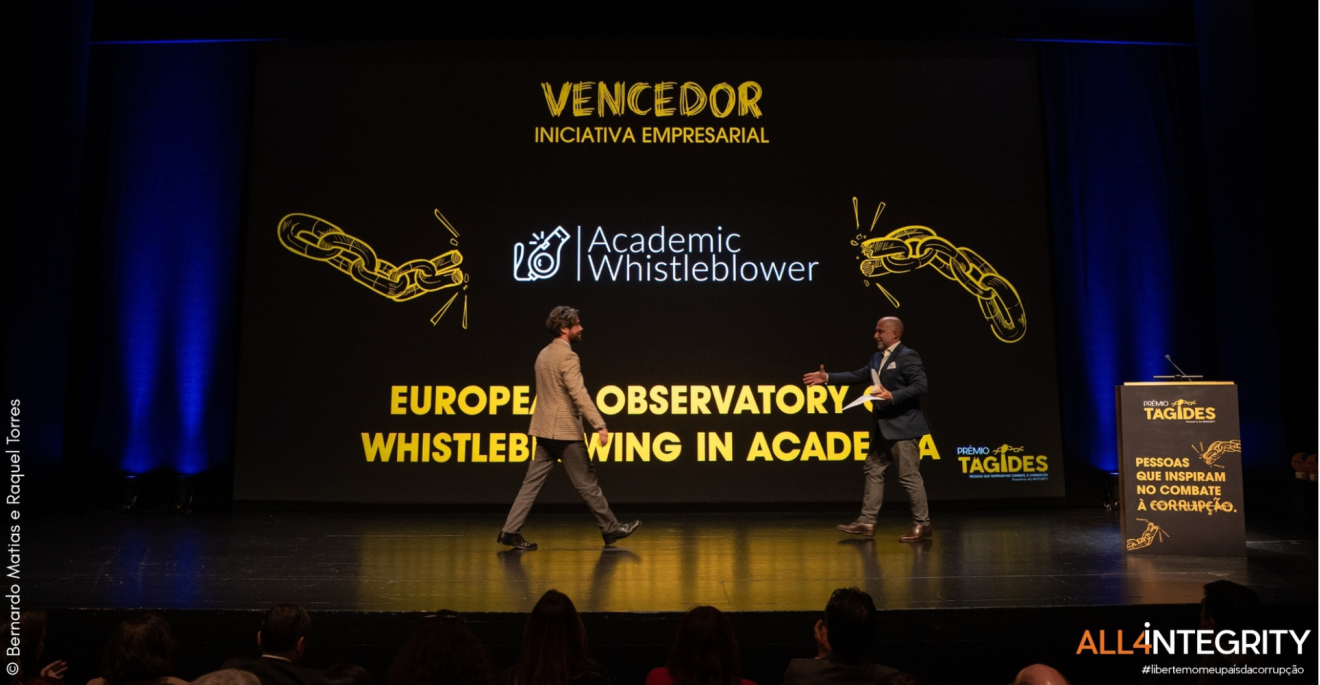
The European Observatory of Whistleblowing in Academia, developed in the framework of the PAndora bOx of whistLeblowing in Academia (PAOLA) project in which the Marie Curie Alumni Association (MCAA) was a consortium partner, has been awarded the Tágides Prize 2025 for its contribution to fostering transparency, integrity, and accountability in academia.
Launched in 2021 by the not-for-profit organisation All4Integrity, the Tágides Prize is awarded annually to recognise and celebrate projects, initiatives, and individuals that stand out in promoting a culture of integrity and in preventing and combating corruption across various sectors in Portugal.
The winners of the 2025 edition of the Tágides Prize in different categories were presented during a ceremony held on 12 March 2026 at the Centro Cultural de Belém in Lisbon. The European Observatory of Whistleblowing in Academia won in the Corporate Initiative category.
“This recognition is a meaningful milestone and achievement for the European Observatory of Whistleblowing in Academia, as it acknowledges the importance of continuing to push the topic of reporting unethical issues in academia, as well as the collective effort behind building a space dedicated to transparency, integrity, accountability, and support in academia,” says Francisco Valente Gonçalves, MCAA member and PAOLA project lead.
Promoting integrity in academia across Europe
The European Observatory of Whistleblowing in Academia was launched in October 2024 as part of the PAOLA project, funded under the Erasmus+ programme, which aimed to raise awareness of whistleblowing in academia and best practices for reporting unethical issues. This pioneering initiative was designed as a centralised hub to provide data, guidance, and resources that support academic integrity while protecting those who report misconduct in Europe’s higher education and research institutions.
Led by Instante Falante, the PAOLA project ran from September 2023 to March 2025, bringing together a diverse consortium, including Stichting Scilink, Transparencia Internacional, Università Commerciale Luigi Bocconi, and Dublin City University, with the MCAA representing the broader academic and research community.
“As a large, independent, and international network of researchers, the MCAA brought credibility and a strong community-based perspective to the project. This helped ensure that the work on academic whistleblowing was grounded in the real experiences and concerns of researchers across different countries, disciplines, and career stages,” reflects Fernanda Bajanca, former MCAA Chair and PAOLA team member.
In addition to raising awareness of the issues faced by researchers through data collection and insights from diverse contexts, the MCAA played a key role in the project’s outreach activities, disseminating its findings, best practices, and tools to amplify its reach and impact.
The MCAA’s involvement in the PAOLA project also brought benefits for the Association’s members, who not only contributed to the development of the European Observatory of Whistleblowing in Academia but also gained access to practical resources to promote ethical standards and address concerns effectively when they arise.
Looking ahead
According to Francisco, the Tágides Prize is not only a recognition but also an encouragement to consolidate and expand the work carried out throughout the project. “This award belongs to everyone who helped to make this project possible, namely, researchers, partners, supporters, and all those who believe academia must be safer than it is currently, and more accountable when malpractices occur. It is an encouragement to continue turning a difficult, often silenced issue into a shared conversation, where everyone’s view is needed and valuable,” he says.
Reflecting on the importance of strengthening whistleblower protection and promoting a culture of integrity within the research ecosystem, Gian Maria Greco, MCAA Chair, leaves a message to those currently facing unethical practices: “Speaking up in academia can feel deeply isolating, especially when you are early in your career, and the power imbalances are so stark. Your voice breaks the status quo and contributes to a much-needed cultural shift toward transparency, accountability, and genuine care for people. Seek out allies, networks, and communities that share a commitment to integrity.”
About the MCAA
The MCAA is a global network of researchers who have benefited from or are benefiting from the Marie Skłodowska-Curie Actions (MSCA). The MCAA supports and contributes to advancing knowledge for a global, diverse, and informed society. Its primary focus is to support its members’ career development, offer networking opportunities, and contribute to shaping research and innovation policies in the EU. Currently, the MCAA has over 24,000 members from 155+ countries, at all career stages and from diverse research fields.