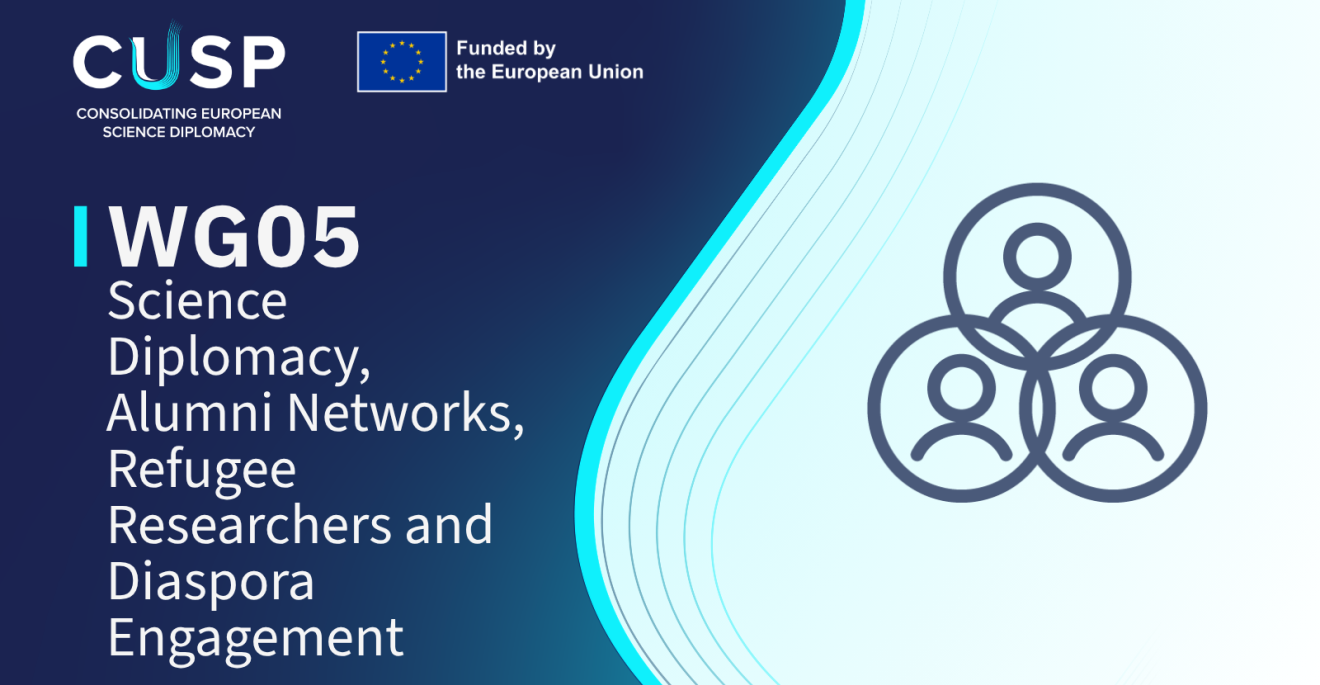
The Consolidating European Science Diplomacy (CUSP) project has opened its call for expressions of interest to join its ten thematic Working Groups (WGs) on science diplomacy. The Marie Curie Alumni Association (MCAA) is pleased to coordinate one of the WGs, “Science Diplomacy, Alumni Networks, Refugee Researchers and Diaspora Engagement” (WG05). Researchers, practitioners, policymakers, and other professionals are invited to apply by 11 November 2026.
The WG05 explores how alumni networks, scientific diasporas, and refugee researchers can contribute to international scientific cooperation and strengthen science diplomacy. It looks at approaches to fostering brain circulation, supporting displaced and at-risk researchers, and mobilising scientific communities across borders.
Building on existing mobility schemes and diaspora networks, the WG will identify good practices and develop recommendations to enhance inclusive and resilient global research collaborations. It will also look at how to better connect scientific communities with diplomatic and policy actors.
Who can apply
The MCAA is looking for individuals with relevant expertise or professional experience related to the WG’s theme. This includes applicants from:
-
Universities and research organisations
-
National, regional or local governments and public administrations
-
Foreign ministries and diplomatic services
-
European and international organisations
-
Research funding and research-performing organisations
-
Civil society and non-governmental organisations
-
Science academies and professional associations
-
Private-sector organisations
-
Science diplomacy networks and initiatives
-
Other organisations or professional communities relevant to the WG theme
Applications are welcome from all career stages, professional backgrounds, disciplines, sectors, countries, and regions.
What does membership involve
The WG will bring together approximately 20–30 members of the science diplomacy community. Members will:
-
Take part in an introductory online meeting between February and March 2027, and around eight online meetings until February 2029
-
Join one in-person thematic workshop, hosted by the MCAA or organised alongside a relevant science diplomacy event
-
Collaborate through the Science Diplomacy Hub and co-develop outputs such as policy briefs, recommendations, reports, and thematic notes
-
Share knowledge and practical experience, and help disseminate the group’s work through their networks
-
Contribute, where relevant, to wider CUSP activities, including the CUSP Conference in June 2028
Membership is free but not remunerated.
How to apply
-
Register as a member of the Science Diplomacy Hub and complete your community profile. Applications can only be considered if the profile is complete.
-
Open the WG application form in "Calls and Surveys".
-
Select up to three WGs and rank them by preference.
-
For each WG, explain how you would like to contribute and your motivation for taking part.
-
Confirm your availability for the full WG period and upload your CV.
-
Submit your application through the Hub by 11 November 2026.
Applications will be assessed by a selection committee. The final composition of each group aims for a balanced mix of expertise, career stages, sectors, geographies, and perspectives. Membership will be announced in January 2027.
CUSP is funded by the European Union. Views and opinions expressed are, however, those of the author(s) only and do not necessarily reflect those of the European Union or the granting authority. Neither the European Union nor the granting authority can be held responsible for them.
About the MCAA
The MCAA is a global network of researchers who have benefited from or are benefiting from the Marie Skłodowska-Curie Actions (MSCA). The MCAA supports and contributes to advancing knowledge for a global, diverse, and informed society. Its primary focus is to support its members’ career development, offer networking opportunities, and contribute to shaping research and innovation policies in the EU. Currently, the MCAA has over 25,000 members from 160+ countries, at all career stages and from diverse research fields.