From evidence to policy action: MCAA conversations on inclusive research assessment
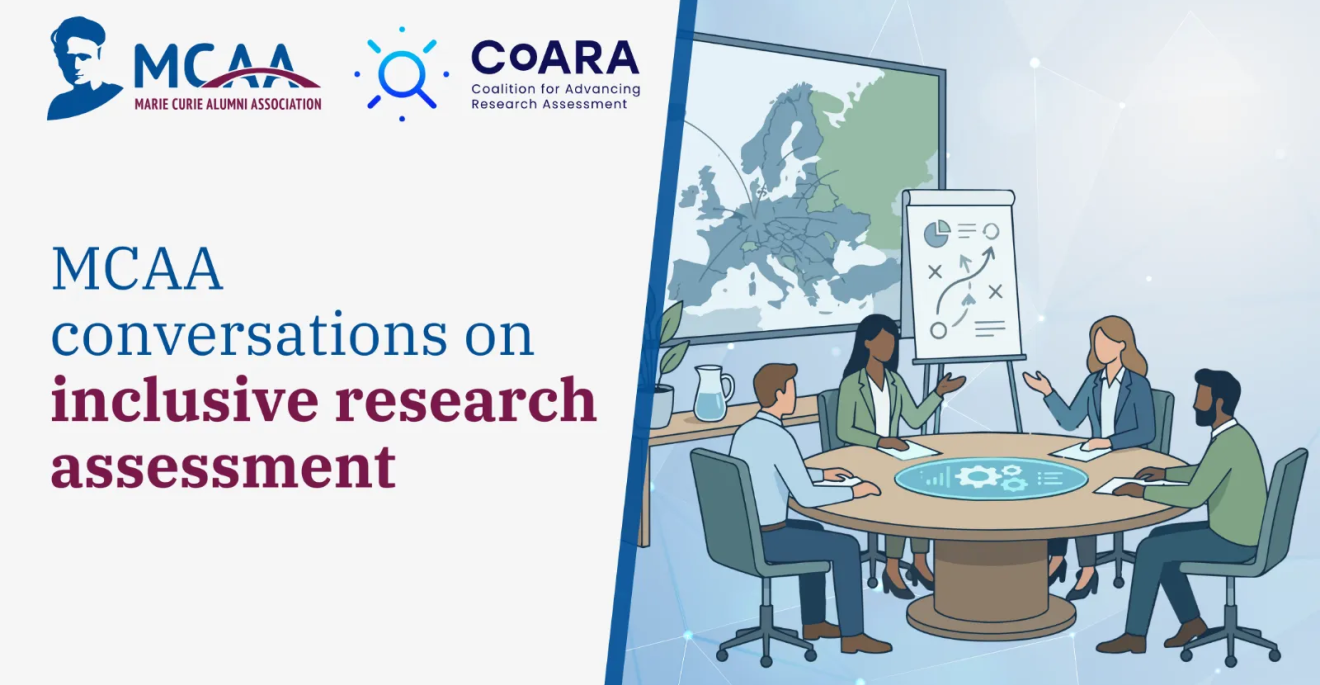
On 14 July 2026, the Marie Curie Alumni Association (MCAA) gathered researchers, policymakers, funders, and university networks at the Press Club Brussels Europe in Belgium and online to discuss inclusive research assessment. The event was part of the dissemination tour of the Coalition for Advancing Research Assessment (CoARA) Working Group Towards an Inclusive Evaluation of Research (TIER).
Gian Maria Greco, MCAA Chair, and Magdalini Theodoridou, CoARA TIER Working Group member and MCAA Board member-elect, opened the afternoon with a simple framing. Reform is no longer a question of whether, but of how. And with the European Research Area (ERA) Act and Framework Programme (FP) 10 currently being drafted, the window to shape them is open, but it will not stay open for long.
What the evidence says
Maura Coniglione, CoARA TIER Working Group member, University of Milano-Bicocca, presented the results of the TIER survey. Women are far more likely than men to see the definition of excellence in their field as gender-biased. That gap holds regardless of the respondent’s age, role or seniority. When asked which biases their institution should tackle first, researchers named gender as the top priority.
Then came the question of what actually counts. At the top: high-impact publications, grants, citations, journal prestige, and the h-index. At the bottom: outreach, open access, diverse publication formats, data collection, and peer review service. Narrative CVs are meant to help with all of this. Only a minority of respondents have actually seen them used.
TIER's answer is practical: a self-assessment toolkit, free and online, open to any research-performing or funding organisation, whether or not it has signed CoARA. It is not a scorecard. It is a way for an institution to see where it stands and what it could do next.
What the policy landscape looks like
Rita Morais, Adviser for Research and Innovation, European University Association, widened the lens from research assessment to academic careers as a whole.
Universities are diverse, she argued, and their career paths should be too. That means recognising teaching, leadership, teamwork, Open Science, knowledge valorisation, and societal outreach as real parts of an academic career. Her key point deserves repeating: this is not about asking researchers to do more. It is about recognising what they already do.
Rita also mentioned a problem that ran throughout the afternoon. We keep invoking excellence without defining it. Without a shared definition, promotion becomes a black box, and black boxes are where bias lives comfortably.
Panel 1: From evidence to policy
Magdalini Theodoridou moderated the first panel with Michael Arentoft, Head of Unit, Open Science and Research Infrastructures, Directorate-General (DG) Research and Innovation, Hana Tenglerova, Policy Officer, Gender Sector, DG Research and Innovation, and Sebastian Dahle, MCAA representative and Vice-Chair of the CoARA national Chapter in Slovenia.
The panel kept returning to one mismatch: research systems reward one thing and need another. Add the conflicting signals researchers get from their institutions and their funders, and the burden is clearly not shared equally. Panellists made the point that bias starts long before anyone is evaluated. It shapes who gets access to networks, resources and opportunities in the first place. And the numbers at either end of the academic career tell their own story: far more women graduate than ever become professors. Something is filtering them out, and treating the symptoms will not fix it.
The messages from upcoming FP10 already carry language on avoiding bias in evaluation. The shared ask for the next phase was monitoring—properly resourced, not left to the goodwill of volunteers.
Panel 2: From policy to practice
Mostafa Moonir Shawrav, MCAA Executive Director, moderated the second panel with Maura Coniglione, Anouk Lafortune, Policy Officer, Choose Europe and Marie Skłodowska-Curie Actions (MSCA), DG Education, Youth, Sport and Culture, and James Morris, Senior Policy Officer, Science Europe.
This panel asked the harder question: what do funders and institutions actually do with the evidence? One warning kept popping up. Changing the criteria is not enough. If you rewrite a criterion without explaining why, do not train the people applying it, and do not redesign the form that captures it, nothing much changes. Reform lives or dies in the details of implementation.
Narrative CVs came up repeatedly, along with a real tension: researchers applying in different countries need enough coherence to know what is expected, while national systems need enough flexibility to work at all. And the advice to institutions was refreshingly simple—start by asking your own researchers. They are the ones who know how evaluation really works.
Closing roundtable: Building a European movement
Gian Maria Greco chaired the closing roundtable with Marina Neophytou, Dean of the Faculty of Engineering, University of Cyprus, and Karen Stroobants, CoARA Steering Board Vice-Chair and MCAA representative.
The final question was the one everyone had been circling back to. What has to happen for inclusive assessment to become normal rather than exceptional?
Declarations, the roundtable agreed, are the easy part. Reform is lived in faculties, where imbalance is a daily reality and where change meets resistance. What helps most is a credible European reference to point to. What also helps is investment and explicit recognition for innovation, valorisation, mentorship and societal impact. Above all, inclusiveness needs to be part of our definition of excellence, not alongside it.
The deeper shift identified was from outputs to outcomes. From what was produced to how it was produced and what it was for. In academia, output has become the currency for individuals and organisations alike, meaning productivity is rewarded while the work that genuinely serves science and society is not.
The evidence shows the movement is changing practice, but unevenly. Where it stalls, the problem is often not a lack of will but national law standing in the way—something the ERA Act could help resolve. Artificial intelligence adds a new wrinkle: polished narratives are now easy to generate, so assessment formats will have to draw out real evidence and real judgment.
And running through it all: researchers need a seat at the table where these decisions are made. Internationally mobile researchers, in particular, are a stress test for the whole system. They cross every boundary it has and feel every inconsistency within it.
The day ended not with new principles but with a deadline. The ERA Act and FP10 are now being drafted, and what goes into them will shape how researchers are judged over the next decade. Inclusive assessment needs to be designed into those frameworks. What we choose to reward today is the research system we will have tomorrow.