Modelling the emotional brain
What can computational models reveal about how the brain processes emotions? During my MSCA doctoral fellowship, I explored how the cerebellum contributes to emotional processing using computational neuroscience. The project shows how interdisciplinary approaches can help uncover hidden brain circuits.
From physics to neuroscience
How can we understand how brain circuits generate emotions?
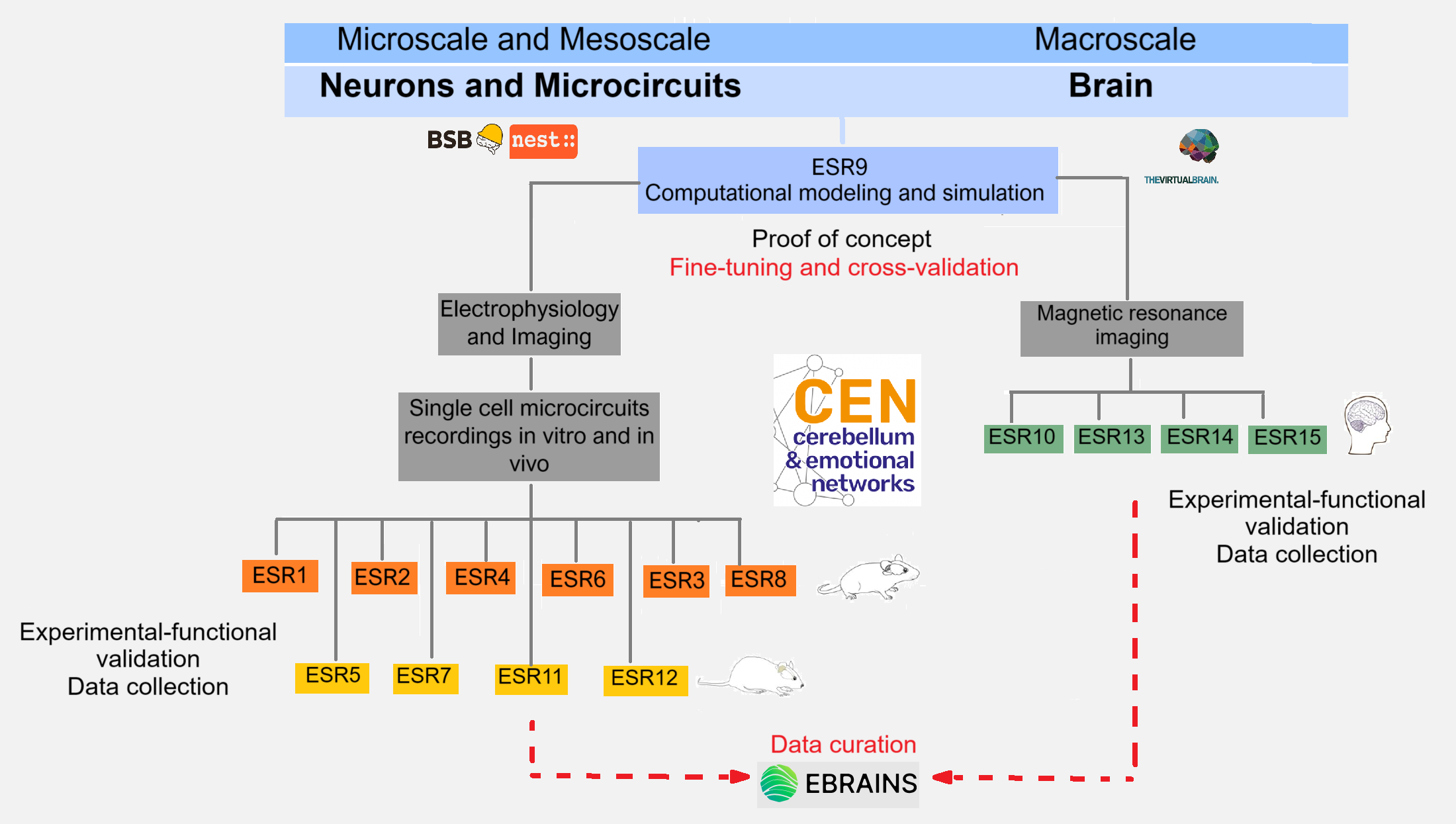
This question guided my doctoral research within the Marie Skłodowska-Curie Innovative Training Network Cerebellum and Emotional Networks (CEN). The project brought together researchers across Europe to investigate how the cerebellum contributes to emotional behaviour.
My own path into this field was somewhat unconventional. I originally trained as a physicist, later specialising in complex systems. These disciplines focus on understanding how interactions between many elements produce collective behaviour. Interestingly, the brain is one of the most complex interacting systems known. This perspective naturally led me toward computational neuroscience.
Studying the emotional cerebellum
For a long time, the cerebellum was mainly associated with motor control. However, growing evidence shows that it also contributes to cognition, emotion, and social behaviour.
Within the CEN network, we explored:
- neuroimaging
- behavioural experiments
- electrophysiology
- computational modelling
I was the only researcher among fifteen doctoral students responsible for the computational modelling component of the project. My goal was not simply to build a model. Instead, I aimed to develop a clear workflow for modelling cerebellar circuits, showing what is currently possible, what data is still missing, and which future directions could help move the field forward.
Computational models allow scientists to simulate neural circuits and explore how their structure and connectivity influence brain activity. These models help integrate different types of biological data and generate new hypotheses that can later be tested experimentally.
In my project, I focused on cerebellar lobule VI, a region increasingly implicated in emotional processing, and developed models that could be used to explore how these networks might participate in emotional learning.
Why fear conditioning?
To investigate emotional processing, we used fear conditioning as a model paradigm. Fear conditioning is widely used in neuroscience because it allows researchers to study emotional learning in both animals and humans using comparable experimental designs. Importantly, there is a large amount of experimental data available for this paradigm.
Rather than producing a definitive model of emotional circuits, the goal of this work was to provide a framework for building biologically grounded models of cerebellar networks involved in emotional behaviour.
Building a roadmap
One important outcome, as well as a major challenge in neuroscience, was identifying what is needed to build realistic brain models. We combined:
- anatomical data about brain structure
- connectivity between neurons
- physiological properties of neural activity
- behavioural and experimental data
Another challenge I encountered during my PhD was the limited availability of datasets linking cerebellar circuits to emotional behaviour. While evidence suggesting cerebellar involvement in emotional processing is growing, detailed datasets are still scarce.
One of the goals of the CEN network was to address this challenge. Through the work of experimental and clinical partners in the consortium, new datasets on cerebellar circuits and emotional behaviour are being generated and will gradually become available to the scientific community.
Working with complex biological systems also means accepting uncertainty. Even when a modelling framework is carefully designed, progress often depends on adapting to the data that are actually available. During my research, I learned that it is important to always have multiple strategies in mind: a plan B, C, or even D.
Building meaningful models is not only about simulation techniques. It is also about understanding the limits of available data and working creatively across disciplines.
When disciplines meet
Coming from physics, I entered a field where many collaborators were experimental neuroscientists, clinicians, and biologists. As the person responsible for modelling the system, I often had to work with concepts from biology and medicine that were completely new to me. When you come from another discipline, people may initially question whether you fully understand the biological system you are trying to model.
At the same time, interdisciplinary work requires recognising that no single discipline holds all the answers. Progress does not come from one discipline trying to dominate another. Instead, it emerges when different forms of expertise complement each other. Finding the balance between biological realism and abstraction is one of the central challenges of computational neuroscience.
Looking ahead
Scientific progress depends on the ability of researchers to share ideas, data, and perspectives. Science advances when researchers are willing to do so. Yet in practice, collaboration across disciplines and open data sharing are still not as common as they could be.
Concerns about competition, authorship, or publishing first sometimes create invisible barriers between researchers. But complex scientific questions, such as understanding how the brain generates behaviour, cannot be solved in isolation. They require integrating different types of knowledge and collaborating across disciplines.
Initiatives promoting open science and collaborative infrastructures are helping to move the field forward. Still, progress will depend not only on new technologies but also on our collective ability to cultivate openness, humility, and trust in the scientific community.
After all, science moves forward not when we work alone, but when we learn to build knowledge together.