Giving older adults a voice in policy and service development
Health systems work best when those most affected help shape them. Yet, older adults and caregivers are still too often treated as passive recipients rather than partners. This gap motivated TRANS-SENIOR, a Horizon 2020 MSCA Doctoral Network uniting academic, care, and civil society partners across six countries to improve care transitions through generating evidence on 1) avoidable care transitions, 2) innovative transitional care models, and 3) citizen engagement.
Why care transitions and why engagement?
Hospital-to-home transitions are among the most vulnerable moments in the care journey of older adults. They are often compressed, fragmented, and poorly coordinated, involving multiple professionals, institutions, and handovers. For patients and caregivers, this period can be confusing, stressful, and risky. Yet, it is precisely here that health systems expect people to manage medications, appointments, rehabilitation, and daily care with minimal support.
As an Early Stage Researcher within the TRANS-SENIOR programme, my research focused on a simple yet profoundly systemic question: How can older adults and informal caregivers be meaningfully engaged in shaping policies and services, such as those governing hospital-to-home transitions? To explore this, my work combined three complementary approaches. First, we conducted a scoping review to map existing strategies. Second, we conducted qualitative, multi-country interviews with stakeholders and decision-makers to understand how engagement is perceived and implemented. Third, we evaluated both traditional (in-depth interviews) and deliberative (citizen panels) engagement methods in Israel.

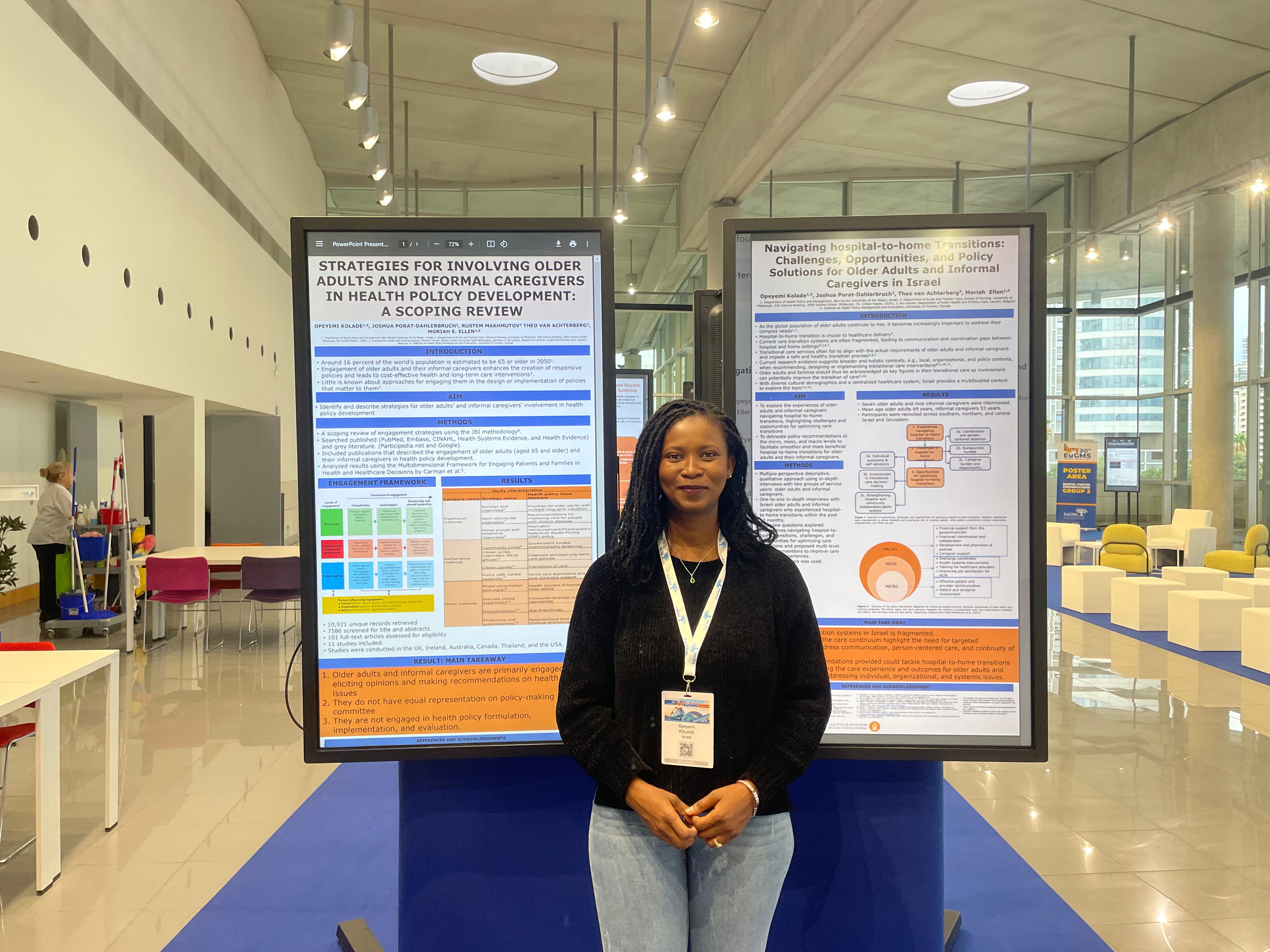
What we found: Engagement is still too shallow
Across countries and settings, one clear pattern emerged: engagement most often occurs at low levels. Older adults and caregivers are frequently asked for their views, but rarely involved as partners in shaping options, co-producing solutions, or developing policies (O. Kolade et al., 2022; O. R. Kolade et al., 2024). Even more rarely do they receive feedback showing how their input influenced decisions.
Our findings suggest that early involvement, structured participatory processes, and visible feedback loops are crucial. Without these, engagement risks become symbolic rather than transformative.
What older adults and caregivers told us about transitions
Participants consistently described hospital-to-home transitions as rushed, fragmented, and poorly explained. Many reported being discharged without clear guidance, while caregivers found themselves suddenly responsible for coordinating complex and disconnected services.
At the same time, these conversations were also rich in solutions. Participants proposed practical and system-relevant improvements: better communication between hospital and community teams, personalised discharge plans, targeted follow-up for high-risk patients, easier access to rehabilitation and support, and a clear point of contact during the transition period (O. R. Kolade et al., 2025b, 2025a).
Citizen panels, beyond identifying challenges and generating recommendations, created space for collective reflection and deliberation. Participants gained clarity, felt heard, and co-developed proposals that addressed not only clinical gaps but also bureaucracy, equity, and caregiver burden.
What this means for policy
These findings point to a simple but powerful conclusion: policies and services designed without the meaningful involvement of those who use them are structurally incomplete. Older adults and caregivers are not merely stakeholders; they are experts by experience.
For policymakers, this means moving beyond ad hoc consultation to embedding participation throughout the policy cycle, from agenda setting and design to policy development, implementation, and evaluation. It also requires investing in institutional capacity, skills for engagement, and evaluating not only clinical outcomes but also system-level and economic impacts of better-designed transitions.
What the MSCA framework made possible
This kind of multi-country, methodologically plural work was made possible within a structure like the Marie Skłodowska-Curie Actions. The TRANS-SENIOR programme provided not just funding, but an ecosystem: interdisciplinary supervision, international secondments, access to policymakers and practitioners, and training that bridges health policy, implementation science, ageing research, and citizen engagement.
Through this environment, I developed skills in scoping and systematic reviews, multi-country qualitative research, and stakeholder engagement. This work has resulted in multiple peer-reviewed publications and policy-oriented outputs. Equally important, working within an implementation-oriented, policy-facing network deepened my understanding of how evidence travels, or fails to travel, into real-world decision-making.
In recognition of this work, I was selected as one of three recipients of the Young Researcher Award at the 4th Swiss Implementation Science Conference (IMPACT Conference) 2026.
Looking forward
TRANS-SENIOR has contributed to a growing European and international conversation on ageing, equity, and person-centred and transitional care. Looking ahead, my research highlights key priorities: strengthening institutional capacity for engagement, embedding participation throughout the policy cycle, and evaluating the system-level impacts of improved transitions.
My goal is to continue building research that reflects what the MSCA stands for: excellent science across borders and sectors, with a real impact on people’s lives. And in this case, that impact begins with a simple but transformative idea: listening to older adults not at the margins of policy, but at its very centre.
References
Kolade, O., Porat-Dahlerbruch, J., Van Achterberg, T., & Ellen, M. (2022). Strategies for engaging senior citizens and their informal caregivers in health policy development: A scoping review protocol. BMJ Open, 12 (10). https://doi.org/10.1136/bmjopen-2022-064505
Kolade, O. R., Porat-Dahlerbruch, J., Makhmutov, R., van Achterberg, T., & Ellen, M. E. (2024). Strategies for engaging older adults and informal caregivers in health policy development: A scoping review. Health Research Policy and Systems, 22(1), 1–17. https://doi.org/10.1186/s12961-024-01107-9
Kolade, O. R., Porat-Dahlerbruch, J., van Achterberg, T., & Ellen, M. E. (2025a). Navigating hospital to home transitions: A qualitative study exploring older adult and informal caregiver experiences, challenges and opportunities. Geriatric Nursing, 65, 103538. https://doi.org/10.1016/j.gerinurse.2025.103538
Kolade, O. R., Porat-Dahlerbruch, J., van Achterberg, T., & Ellen, M. E. (2025b). Policy interventions for improving hospital-to-home transitions of care for older adults and informal caregivers: A qualitative study. Israel Journal of Health Policy Research, 14(1), 1–14. https://doi.org/10.1186/s13584-025-00692-6
Opeyemi Kolade
Ben-Gurion University of the Negev, Israel
KU Leuven, Belgium
[email protected]
ORCiD