Economic models and where to find them
What does it take to understand how climate policies affect economies and societies? During my Martí i Franquès COFUND fellowship and beyond, I explored economic modelling and what these tools can and cannot tell us about designing a just transition.
During my PhD, as a Martí i Franquès COFUND fellow, I wanted to learn a type of economic model that is widely used to analyse climate and energy policy. Instead, most of my research relied on input-output (IO) modelling, another well-established approach in economics. I attended courses and summer schools, understood the theory, but never felt confident applying these models myself.
The type of model I had been trying to learn is called a Computable General Equilibrium (CGE) model. Looking back, I realised that learning a method works best when you have a real problem to solve and someone to catch your mistakes along the way. That environment for CGE modelling was not quite there during my PhD.
So after finishing, I went looking for it.
I soon discovered that relatively few organisations around the world develop and apply CGE models in practice. Most of them are international organisations or government bodies, and they are typically looking for CGE experts, not CGE enthusiasts. After a long search, I found a position where I could finally learn and apply CGE modelling to real policy questions. That place works with GEM-E3, one of Europe's most widely used CGE models, and I am genuinely excited to share what I have been learning.
What do economic models actually do?
Designing climate policy is not straightforward. Every decision involves trade-offs between emissions reduction, economic performance, and social equity, and these trade-offs are rarely obvious at first glance. Economic models help make them visible.
CGE models like GEM-E3 are economy-wide frameworks. They represent how different parts of the economy interact, including production, consumption, trade, energy use, and emissions, all within a single consistent structure. This is what distinguishes them from IO modelling. IO models are powerful for tracing supply chain effects, but CGE models go further: they capture behavioural responses, price changes, and feedback loops across the entire economy.
A simple example: if you introduce a carbon price, energy costs rise. That affects production costs, which ripples into consumer prices, trade competitiveness, and labour markets. Without an economy-wide model, many of these effects stay hidden.
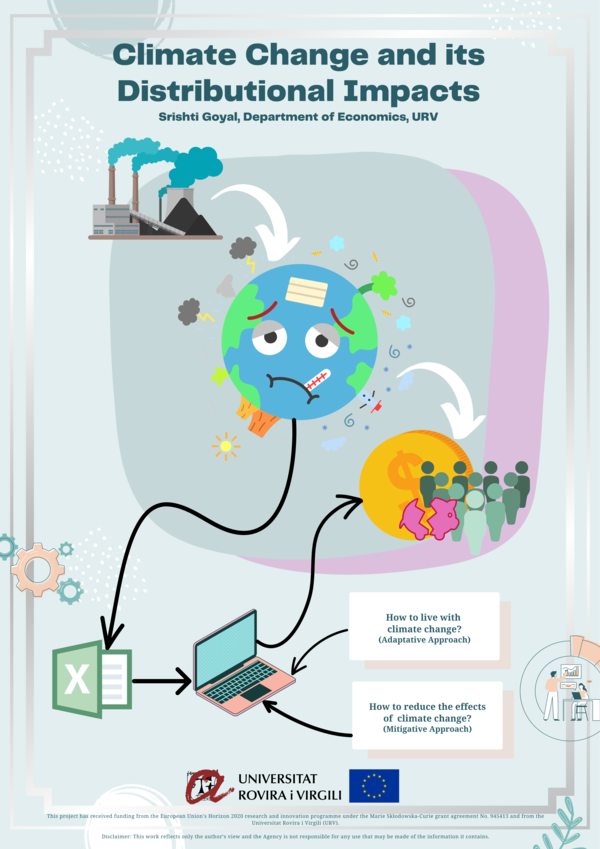
Why does this matter for a just transition?
The just transition is the idea that moving to a low-carbon economy must be fair as well as effective. But “just” means different things to different people. Who bears the cost of decarbonisation? Which regions or income groups are most affected? Which workers face job losses, and where might new opportunities emerge?
These are distributional questions, and they require distributional answers. Tools like GEM-E3 are particularly valuable here because they can simulate not just aggregate economic outcomes, but how impacts are spread across sectors, households, and countries. This makes trade-offs visible in a way that supports more transparent, evidence-based policy debates.
In the EU, models like GEM-E3 underpin impact assessments and long-term strategies such as the European Green Deal. Similar models are also widely used by organisations such as the World Bank, the IMF, and the WTO, which gives a sense of how central this kind of analysis has become to global economic governance.
Models inform, but do not decide
Economic models are not crystal balls. Their results depend on assumptions about behaviour, technology, and market structure. They can tell you what might happen under a given set of conditions, not what will happen. And they cannot capture everything. Social dynamics, political feasibility, and lived experience lie beyond what any model can quantify.
This is where co-creation becomes important in practice. When modellers work alongside domain experts, policymakers, and stakeholders throughout the research process, the assumptions built into models become better grounded in real-world constraints. It also helps ensure that the right questions are being asked in the first place, not just the ones that are easiest to model.
In large European research frameworks such as Horizon Europe, this collaboration also extends to how models are combined technically. It is common for multiple models to be soft-linked, meaning the outputs of one model serve as inputs to another. For example, energy system models may generate technology pathways that feed into macroeconomic models like GEM-E3. This integration allows for a more comprehensive picture of complex transitions than any single model could provide on its own.
Modelling is therefore best understood as a tool that informs judgement, not one that replaces it. A just transition requires not only robust analytical tools, but also inclusive processes that reflect the perspectives of those most affected.
After years of studying these tools without fully applying them, I am glad to now work with them in practice. If you are curious about how economic models shape the policy world around us, I hope this offers a useful starting point, and perhaps some encouragement if you are still searching for the right environment to grow into the work you want to do.