10 tips to write an eye-catching CV for non-academic roles
The MCAA has initiated a series of webinars that run each second Friday of the month starting from December 2021. The aim is to provide educational webinars to the MCAA members and non-members as a way to thank for the support received all these years. The webinars are co-organised by the Communication WG in collaboration with a different MCAA Chapter or working group each month and will cover a variety of topics.
The first episode, co-organised by the Brazil Chapter, saw the participation of Chaperone, the first online marketplace of personalised career development services for scientists.
The CV represents the first impression that your new potential employer will have of you. It is a tool that helps to capture the attention of the recruiters and make them invite you for the interview to learn more about you. That’s why it is important to ask yourself what you want to showcase in your CV and which first impression you want recruiters to think of you, this crucially depends on the job that you apply for.
We discuss below a series of tips and tricks to support and improve your CV writing especially if you want to transition to a non-academic role.
Thank you to Catarina Seabra for having presented the topic.
1. Less is more
Your CV could be read in less than 8 seconds in the initial round of reviews. The recruiters simply don’t have time, thus, it is an opportunity for you to facilitate their job and write down what they need to read and that you have what they are looking for. Even though you have an extensive career and you feel like your CV can be 10 pages long, have a clean template and focus on showcasing the skills required for that particular position.
2. Use an intelligent design: simple, efficient, professional, that causes an immediate impact
Check different existing repositories such as Word Templates or Canva or other software where you can find the design that suits your profile and that matches the design of the company. Make sure that it looks clean and personalised.
CV Design Checklist
- If you choose to include a photo (note: check out the standards for the country you are applying), choose wisely
- Use up to two fonts
- Do not include logos of companies or institutions
- More relevant points are always first
- Avoid long block texts
- Important points should be aligned on the left
- Take the advantage of columns for an intelligent space usage
- Use bullet points and bold to highlight keywords
- Number publications from last to first and use links in PDF
- Add the page number on footnote (e.g., Name Surname | CV | Page 1 of 2)
- Send the CV in a PDF format, and include your name in the file name
3. Reduce size and information
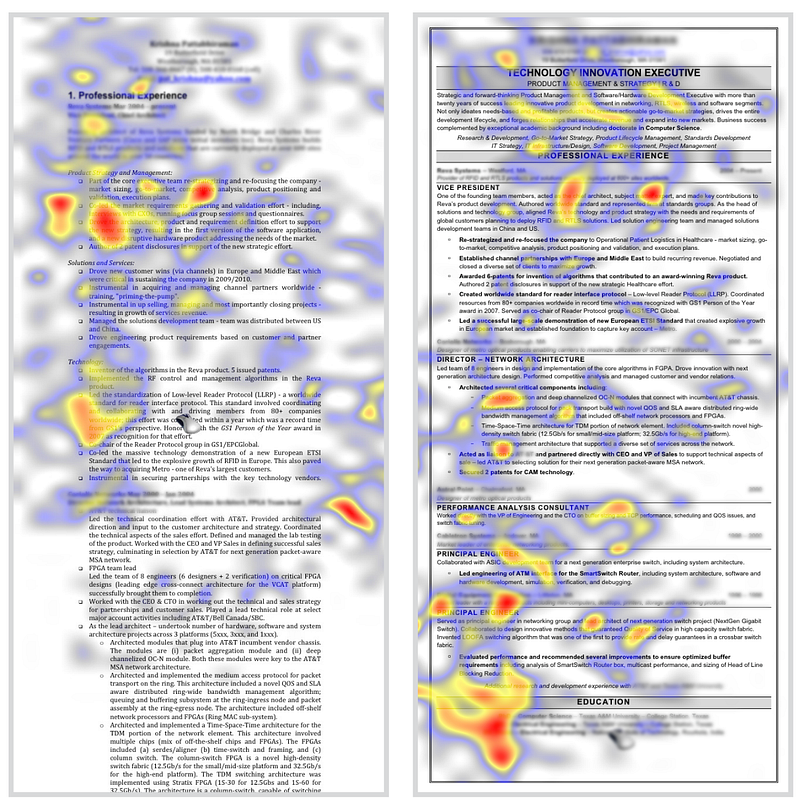
The place and order on which we write our qualifications, experience, skills, or achievements should not be arbitrary. Make sure to add only the information that is necessary for the specific role you are applying for. Interestingly, according to a study by TheLadders, the left and the top parts of the CVs are the most checked ones by the recruiters when reading the CVs.
4. Each application deserves a different CV
“It’s not about you, it’s about them!”
Read about the company or institution of interest, do your homework, check what their goals and missions are, how your profile is aligned with them, and showcase this on your CV. It’s about what they need.
5. Tailor your CV
Read the job post carefully. Focus on what’s more relevant, what really matters for that job in particular. Be ready with different CVs templates and choose the one that suits best the position you are applying to, e.g, business-orientated or consulting-orientated. Think if it is an added value listing all your publications. Also, the job requirements give you hints to help you when it comes to adapting your CV.
6. Describe your experience with meaningful sentences
Pay attention to the keywords that you are using on your CV. Key actions associated with those skills are important in highlighting your expertise. The Harvard Competencies Dictionary can help in this sense.
Active verbs send a more powerful message, for example:
- Demonstrated successes -> Achieved, Built, Created
- Proven track record -> Delivered, Executed, Impacted
- Responsible for -> Managed, Led, Raised
- Duties included -> Optimised, Spearheaded
- Excellent communication skills -> Influenced, Advised, Negotiated
7. The summary must show alignment with the profile in the job specifications and cover letter
The summary is a “snapshot” of who you are. It is about your main achievements and main interests. It is a way to explain your competencies. One paragraph length is suggested. The recruiter may read solely the summary for the initial selection of candidates. Thus, this represents another occasion for you to make the job of the recruiter easier.
8. Don’t underestimate the importance of proofreading
Make sure you have no mistakes, that everything is aligned, and that you don’t have extra bullet points that are not filled in. This shows them that you are motivated in getting the position and that you put the effort into writing your CV.

9. Don’t oversell or lie in your CV
Don’t try to be someone that you are not! Be true about what you really know and who you are.
10. Use your CV as a tool for personal and professional growth
Lastly, use your CV for self-knowledge and self-evaluation. Use it to monitor your goals and to define a plan for the future. Review it every 6 months.
When you send your CV, the recruiters see qualifications, experience and skills, and not your passion, motivation, values and personality. Don’t forget about the Cover Letter! Your CV focuses on your past, while the cover letter focuses on your future, i.e., the difference you can make for the company offering the job position you are applying for.
If you want to know more on how to draft a CV and you feel like you need some extra support, Chaperone is the first online marketplace of personalised career development services for scientists. You can find them at:
MCAA members have a discount on Chaperone services; if you are interested email Chaperone Team at: [email protected].
Authors
Nicoleta Spînu, vice-chair of the Communication WG.
Ruben Riosa, chair of the Communication WG.