Cancer Vaccines: a distant utopia or an immediate future?
by Foivos Lazaris
The following Blog has been developed by one of the participant of the recent MCAA ECS Satellite event on Science Communication.
During the workshop, participants were invited to work on a scientific blog and submit their final piece to be published on the MCAA Blog.
The piece has been revised by a task-force of the MCAA Communication Working Group. Members of the team included: Maria Montefinese, Luisa Merz, Ashish Avasthi, Pradeep Eranti, Nicoleta Spînu, and Ruben Riosa.
Enjoy the piece!
Have you ever imagined how it would be like to live in London during the Great Plague, in Europe during the Spanish Flu, or in the United States during the Polio epidemic? Fortunately, you don’t have to, because our body and immune system are already well prepared for these pathogens. However, there is a key difference between these three events: In the first two cases, the diseases disappeared after killing millions of people, while in the last case the disease was eradicated because of a vaccine.
Even though vaccines have been around for quite a long time since 1796, when the English physician Edwards Jenner developed the first vaccine against smallpox [1] — it was not until recently and due to the severe COVID-19 pandemic that they attracted a lot of attention. Despite the recent advances in the biological, chemical, and medical sciences, it seems that people are more concerned than ever about getting vaccinated, which raises the question how easily an anti-cancer vaccine could be introduced to the general public.
In my opinion, as a researcher working in vaccine development, and more specifically in antigen development, the problem lies in the apparent complexity of the field, the lack of knowledge and information of the general public, and the way that scientists are perceived by society. For that reason, let us explore together how a vaccine is actually developed, the rational design and the step-by-step process behind the scenes, and why vaccines can be a great addition to our arsenal against cancer.
The development process consists of three main parts: antigen development, formulation, and evaluation of the biological activity. An antigen is a protein or any molecule that can activate the immune system; it may or may not be pathologic. Once an antigen is recognized by the immune system, a series of events is kicked off, resulting in the production of specific antibodies that can only recognize a certain antigen [2]. Imagine that the antigen-antibody relationship is similar to a key lock. This is the tricky part of antigen development; as mentioned before, some antigens may have a pathological function or they are not immunogenic (activate the immune system) enough; so they cannot be introduced directly to the body; they need to be modified first [3]! These modifications can be anything, varying from minor to major changes in the amino acid sequence of the protein (the amino acids are the building blocks of the protein). They are used either to enhance the immunogenicity of the molecule, to suppress its pathological function, or to do both. The amino acids have specific structures and properties, and any modifications can and will alter their structure and biological activity. For that reason, when modifying proteins to enhance their antigen potential, we have to be sure that the general structure of the modified protein will not be different from the initial one, otherwise, the vaccine will not work [2,3]. Nowadays, we have a lot of tools (computer modeling, animal studies, international collaborations) to design and produce safe and effective antigens.
The most important part of a vaccine is the antigen. Although antigen development is one thing, formulating the antigen and evaluating the vaccine performance is another. The formulation is the way that the vaccine, in this case, the antigen, will be delivered to the body and, to an extent, to the immune system. It plays an important role in the efficacy and safety of any pharmaceutical product, especially in vaccines [4]. For example, the formulation can target the part of your body in which the drug, or antigen will be administered, the duration of this delivery (instant or over time), and the way of administration. The same substance can be dangerous, effective, safe, or completely useless, based on its formulation. In my case, I am working with nano-vaccines, so the formulation that applies to my work are the nanomaterials/nanoparticles used. Nanoparticles have already been used as drug carriers for years, and their safety, and biocompatibility, and other properties have already been demonstrated [5].
Regarding the biological evaluation of the vaccine: it is done in many different stages, and I will not be going into details [6]. In general, it is a very long process, with many checkpoints and evaluations, and, usually, it takes years before a vaccine starts to be administered to people. The biological evaluation starts with informatic simulations and experiments in cell cultures, followed by many experiments in animals. After a series of successful experiments and the safety of the product being well established for humans, the vaccine will start its first clinical trial. If that proves successful, the tone of clinical trials will be repeated, and, if they are also proven successful, it will move to the general population. It is quite a long and detailed process that involves numerous people, isn’t it?
A few years ago, talking about an anti-cancer vaccine seemed utopian and would definitely bring laughter to a scientist working in this field. The same happened to the mapping of the human genome thirty years ago. The scientific community at the time thought that this would be a decades-long process, but the developments in computer automation proved them wrong. As a researcher actively working on the development of an anti-cancer vaccine, I can reassure you that this utopia is not that far away. The challenge when creating a cancer-targeting vaccine is that the antigen is a self-antigen; basically, a protein that our body naturally produces and that has a biological function that may or may not be crucial for the body [3].
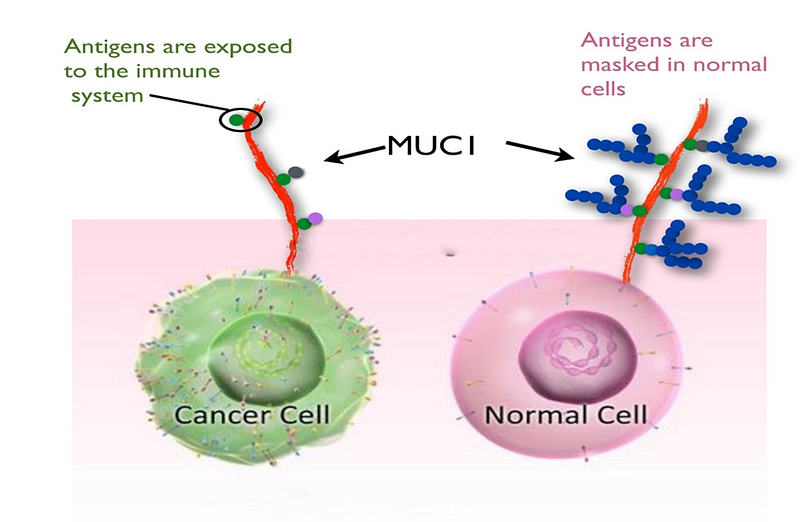
At first glance, targeting a self-antigen brings up two main issues: firstly, how can we train our immune system to recognize our own proteins, and secondly, targeting a self-antigen would not trigger an autoimmune disease? These were the two main questions that made the development of such a vaccine an impossible task. However, researchers have identified certain proteins (glycoproteins, to be exact), mucins, that exert some properties that make them excellent cancer antigens. Mucins are met on the membrane of both healthy and cancer cells but with different post-translational modifications (these are the modifications that our body normally applies to its proteins to make them functional), and more specifically with different post-glycosylation patterns [7,8,9]. In simple terms, glycosylation adds small units to the proteins which can change and hide their structure. Mucins are highly glycosylated when found in the membranes of the healthy cells but completely naked or underglycosylated in cancer cells [9]. This key difference means that we can safely and effectively target the protein without worrying about any side effects, since in healthy cells the mucins are hidden from the components of the immune system by their naturally occurring glycosylation patterns [2].
In conclusion, the development of a safe and effective cancer vaccine is a complex and challenging task that requires extensive research and evaluation. Although, recent advances in cancer immunotherapy have shown promising results in activating the immune system to fight cancer, the development of an anti-cancer vaccine requires further work and devotion. However, with the dedication and expertise of scientists and researchers in the field, the development of an effective and safe anti-cancer vaccine is within reach.
References
- Riedel, S. Proc (Bayl Univ Med Cent). 2005,1,21–5.
- Chaplin, D.D. J Allergy Clin Immunol. 2010, 125,3–23.
- Kacen, A., Javitt, A., Kramer, M.P. Nat Biotechnol 2023,41, 239–251.
- D’Amico, C., Fontana, F. Drug Deliv. and Transl. Res. 2021,11, 353–372.
- Afzal, O., Altamimi, A.S.A. Nanomaterials (Basel). 2022 Dec 24,4494.
- Clinical evaluation of new vaccines — Scientific guideline | European Medicines Agency (europa.eu)
- Pihno and Reis Nat. Rev. Cancer 2015, 15, 540–555.
- Hollingsworth, M., Swanson, B. Nat. Rev. Cancer. 2004, 4, 45–60.
- Nath, S., Mukherjee, P. Trends Mol Med. 2014, 6, 332–42.


