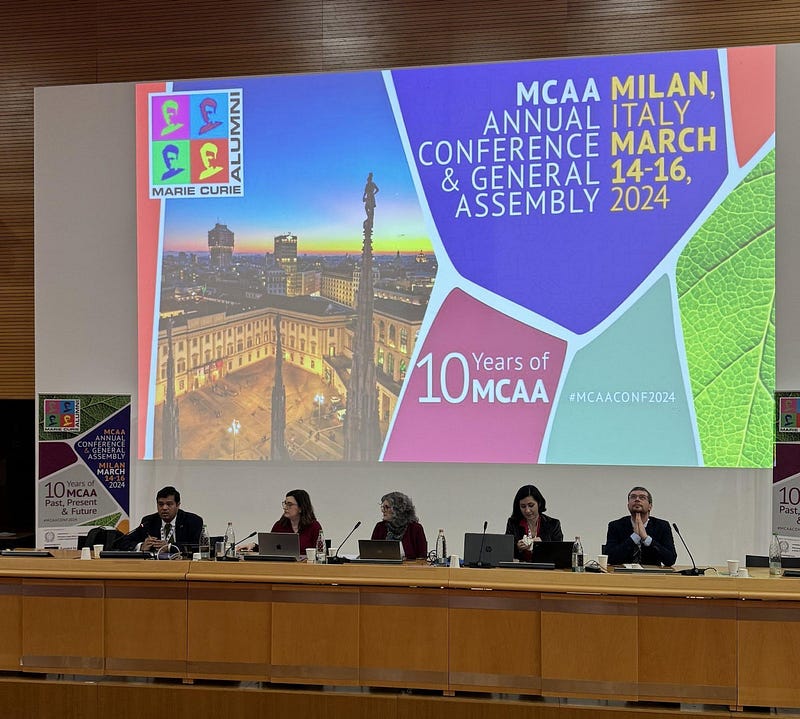
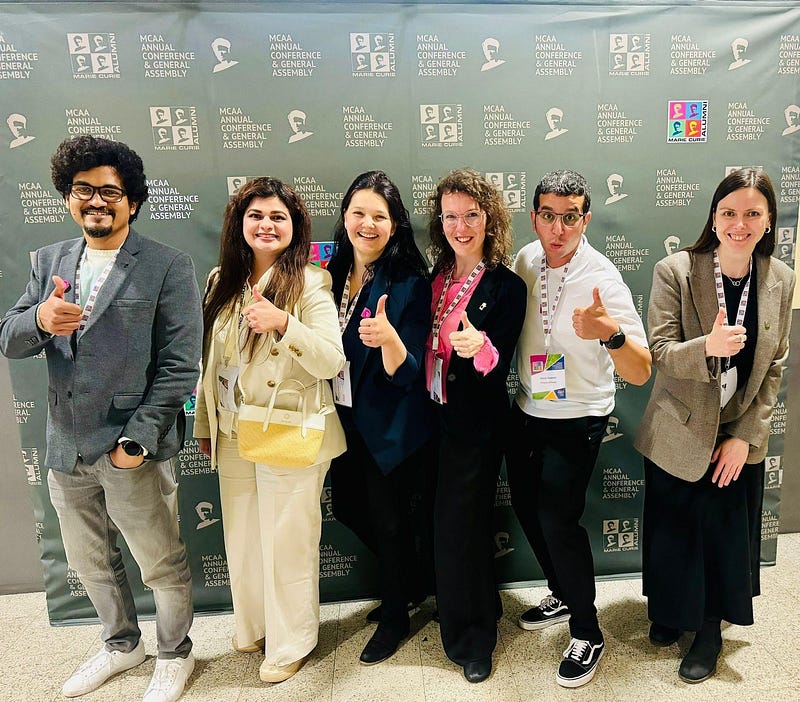
This is a crocodile: A true story at the MCAA Conference, Milan
by Ricardo Domínguez Jover
During the MCAA Annual Conference 2024, the Communications Working Group organized an exciting blogging contest. Participants were invited to write insightful blogs covering various sessions throughout the conference and capturing key insights. After receiving several compelling entries, the best entries, showcasing exceptional quality and reporting, were published and honored with awards. This contest not only encouraged attendees to engage deeply with the conference content but also provided a platform for sharing diverse perspectives and highlights from the event. This initiative fostered active participation and highlighted the conference’s rich array of topics.
“This is a crocodile,” I said to a young man in a suit who had just sat next to me at the Marie Curie Alumni Association (MCAA) Gala Dinner while showing him a piece of bread I was holding in my hand. “Excuse me?” — he said. “This is a crocodile” — I repeated insistently and decisively. “I’m sorry, I don’t think I’m understanding something” — he replied.
Sebastian Dahle could not believe the categorical statement he was hearing, so I clarified: “This is a game. When I tell you the first time that this is a crocodile, you have to answer with surprise, and the second time I tell you, with relief. And then pass it on to the person next to you”. The nine of us sitting at the table played the game for quite a while, despite the grumbling of some who didn’t feel comfortable doing this kind of childish thing at such a solemn event as the Gala Dinner of this association of prestigious researchers. Indeed, as the game progressed, they had to express their emotions and try to imitate the feelings of others.
At one point, the crocodile came into the hands of Iryna Mikhailova, who was at another table and to whom we had explained the game’s features beforehand. When it was her turn, she said, “This is not a crocodile. This is a piece of bread”. Sabina Cveček, who was the person trying to make Iryna believe she was holding a crocodile in her hand, insisted. “This is a crocodile”. “No, this is not a crocodile”, Iryna said again, addressing her interlocutor in a slightly threatening tone”. Then Virginia Martin, who had participated in the game from the beginning, snatched the piece of bread from Iryna’s hands and said: “This is a piece of bread”. At that moment, Iryna’s face changed, showing a certain distrust that she accompanied with a soft grunt and who, at Virginia’s insistence, finally responded relieved, “Oh, yes, this is a piece of bread.”
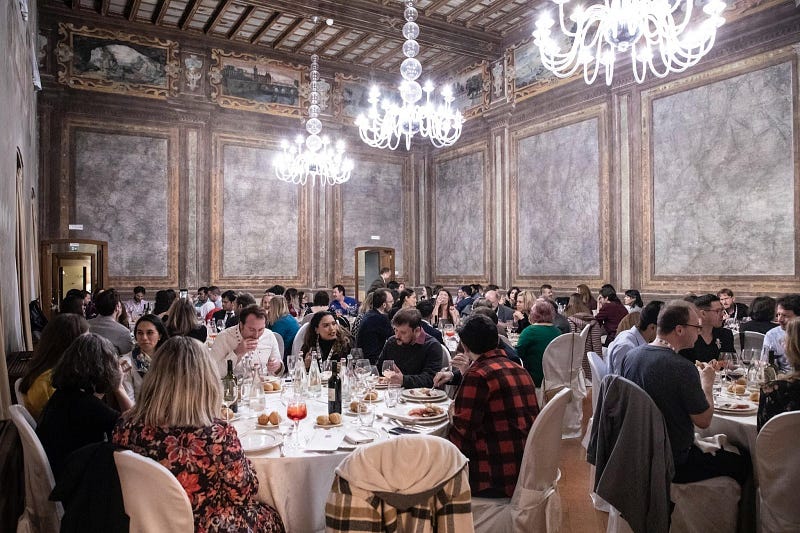
“My intention was only to show that there are people who perceive reality as it is,” said Iryna, clearly referring to people with Autism Spectrum Disorder (ASD). I’m sorry I spoiled the game.” As she commented, and much to my regret, from a scientific point of view, that piece of bread that had passed unnoticed like a crocodile through the hands of researchers from all over the world could not be considered a crocodile.
Determined to play along, given Iryna’s closer and friendlier countenance, I asked her, “Should science and science communication really be devoid of the fictional discourse? Before I let her answer, with the courage that comes from having drunk a few glasses of wine over dinner, I asked:
“Do you know Socrates? Plato and even Socrates are identified as having generated knowledge that did not belong to them. History has made them appear to be the only great thinkers, but the knowledge and thought attributed to them were generated by many other philosophers. Therefore, history constitutes some kind of fiction.”
Then, I repeated, “Do you know Socrates? Do you agree with me?”. Iryna, somewhat embarrassed, nodded. “Yes, I agree with you. And I also know Socrates, I am a Doctor of the History of Philosophy.”
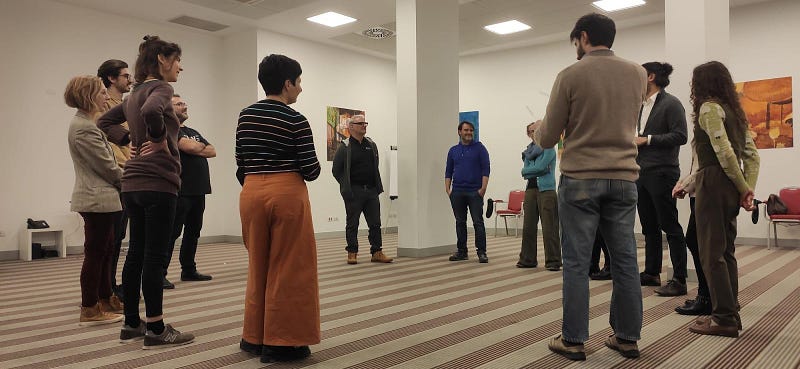
Before coming to Milan, I looked through the conference programme and found up to four sessions dedicated to science communication. The one that caught my attention the most was the satellite event on day 0: Improvisation Theatre Techniques for Effective Science Communication. Some years ago, I participated in a training called “Therapeutic Theatre: Laboratory of Emotions”, where I enjoyed a very amusing and enriching personal experience.
So I said to myself, why not? Then I decided to sign up for the MCAA Improvisation Theatre activity with a clear objective: to have a good time and have fun. And I did have fun, but not only me; the laughter and the excellent atmosphere were the common denominator among the 20 people who participated that afternoon in the activity (Noelia, Greta, Ramu, Francesco, Carla, Renato, Corinne, Manuella, Sabina and much more).
The more than three-hour session was filled with presentations and games of all kinds, starting with the crocodile game. All the group members interacted constantly until it was time for the public presentation of our professional work. There was not a single person who didn’t learn how to tell a good story better.
From Ramu, who studies the chemistry of cancer, to Francesco, who works with social robots, to Noelia, who, among other neuroscientific subjects, is dedicated to the study of mental illnesses suffered by researchers throughout their careers, all of us in the theater activity were open to playing with the rest as a way of learning.
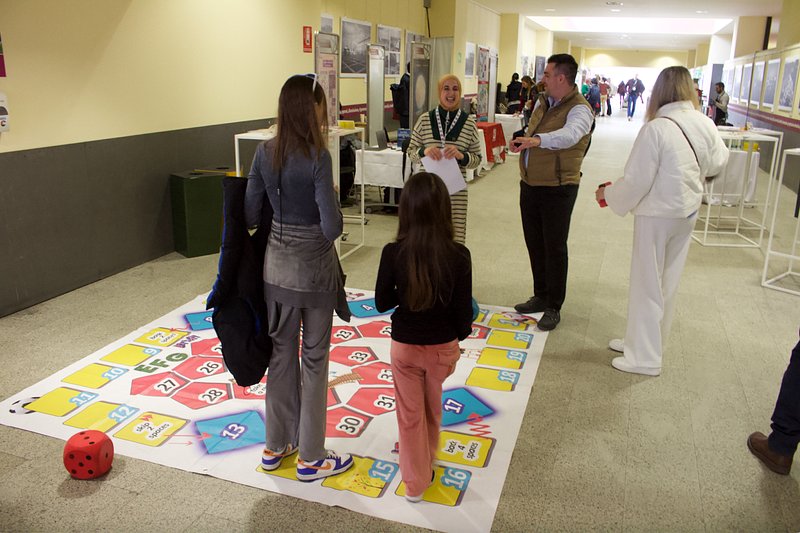
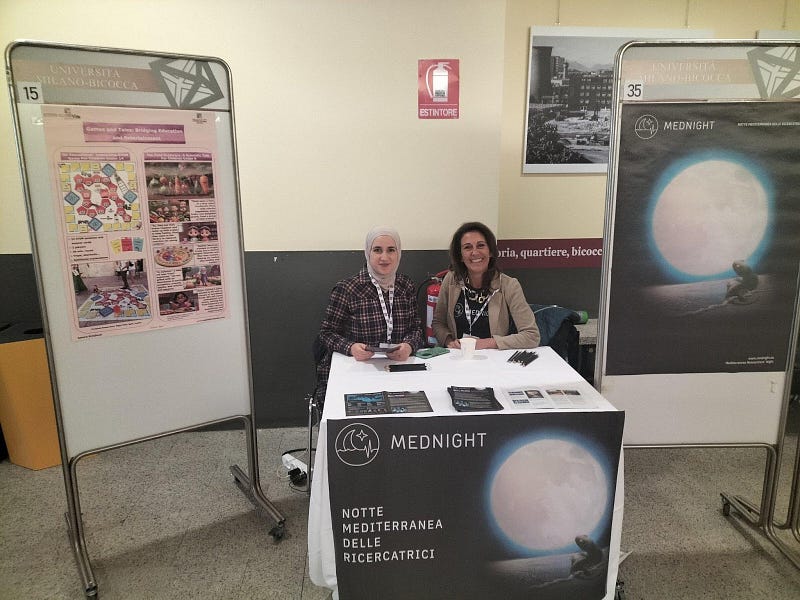
Once at the conference, Marina Trimarchi, Coordinator of the MEDNIGHT project, and I shared space with Samira Smajlović, author of the winning poster among all those presented at the MCAA conference. In it, she unveiled two games aimed at young people under 14 and 8 years old, respectively, the premise of which was participation: they were the protagonists of the action. The first game is similar to the “Snakes & Ladders” game, including scientific questions to be solved before rolling the dice again and changing cells. Samira presented the poster, played with children and adults and participated in the parallel session “Science Communication: Success Stories & Future Directions”.
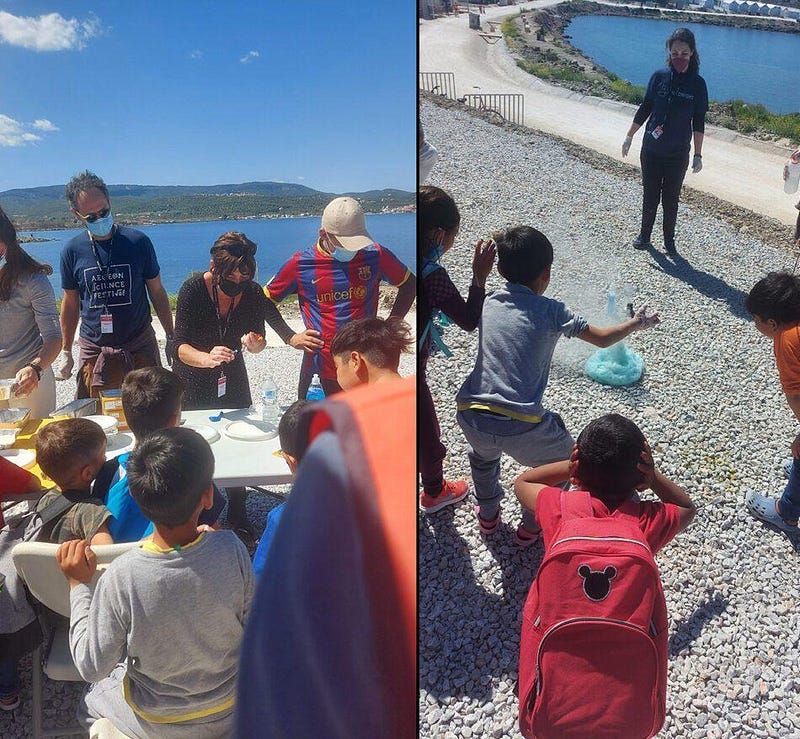
On the other hand, partners from MEDNIGHT, an outreach project funded by the Marie S. Curie Actions and Citizens, are organizing more than 500 activities all around the Mediterranean, such as exhibitions, talks, workshops, visits to schools, scientific art happenings, scientific games, hands-on experiments, dramatized routes, fiction and nonfiction science films, and Guerrilla Science events, among others.
What do these success stories have in common? Beyond the unidirectional communication of a scientific talk or a typical exhibition, the target audience plays a fundamental role in the activities in these cases. Through games, as in the case of Samira or hands-on experiments, competitions and Guerrilla science events, in the case of MEDNIGHT, we teach young people of any age and social status that they can become scientists if they set their minds to it. Imagination, metaphors and, of course, fiction are the key.
Coming back to the game with Iryna, it evolved into a debate about researchers’ demands for/with scientific rigour when transmitting knowledge to our peers and non-peers. Should we accept that fiction is part of the historical construction of science and that the scientific method allows us to open the dialogue beyond what it might initially seem?
After all, at the MCAA Gala Dinner, 90% of the scientists I spoke to saw a crocodile on a piece of bread.