Dialogue — a cornerstone of democracy
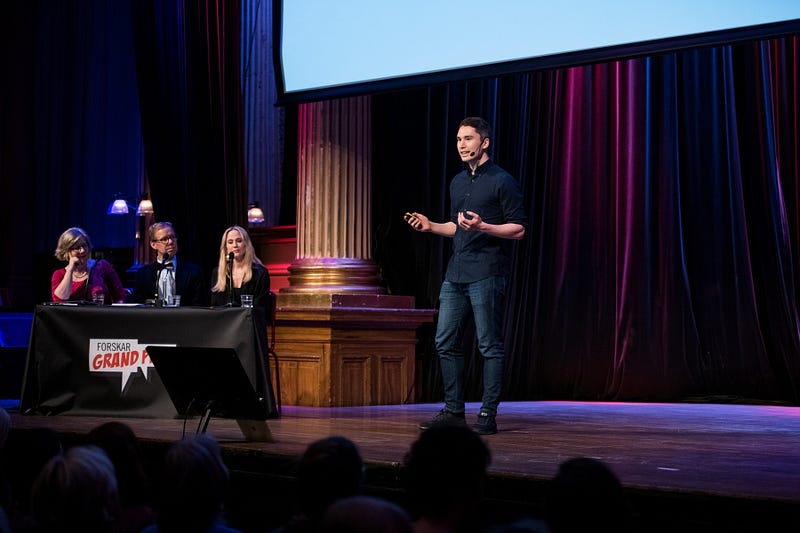
Every year, around 40 researchers in Sweden take on this challenge in the Researchers’ Grand Prix, a competition run as part of European Researchers’ Night in Sweden.
With activities in over 300 cities in 26 countries in Europe and beyond, European Researchers’ Night reaches more than a million people every year on the last Friday of September. The events show how fun and exciting research can be and how important it is to our everyday lives.
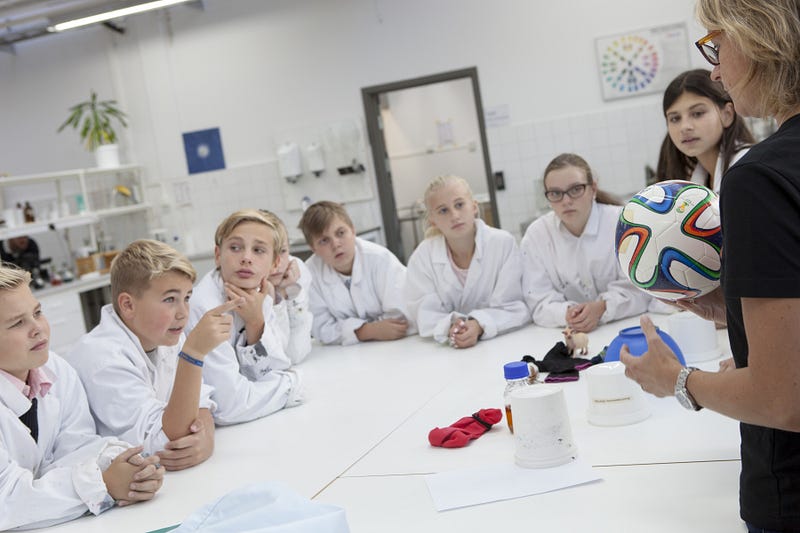
Participating in the activities does not have to be as stressful as in the competition described above. The researchers guide school classes in the lab or host experiments, workshops or demonstrations. They also engage in scientific discussions in cafés and pubs, as well as visiting schools. Other activities include hosting a show, talking to passers-by in a shopping mall and participating in speed dating with the visitors.
The Swedish events have been co-ordinated nationally under the name ForskarFredag (Researchers’ Friday) since 2006 and is Sweden’s most widespread science festival. In 2017, over 450 activities were organised in 28 cities, engaging around 500 researchers. The local activities are organised by, for example, universities, science centres, museums, research centres, governmental organisations and municipalities, in partnership with local organisations and sponsors. Collectively, the events are co-ordinated by the Swedish organisation VA (Public & Science).
Dialogue and openness: a cornerstone
VA (Public & Science; known as Vetenskap & Allmänhet in Swedish) is a non-profit, non-political, independent member organisation that works to promote dialogue and openness between researchers and the public. Its 80 member organisations represent different sectors of society and its remit includes carrying out studies, developing new meeting formats, communication, and advocacy work. The organisation is financed through membership fees, project grants and funding from the Swedish Ministry of Education and Research.
Our annual survey the VA Barometer shows that confidence and trust in researchers is high in Sweden and that the public in general is interested in science. But it also indicates some challenges, for example many Swedes only have a vague conception of several research fields, particularly the humanities.
VA is not only active in Sweden but also works at an international level. VA’s Director of Research is the chair of the EC Advisory Group for SwafS (Science with and for Society) and VA coordinates a national advocacy platform for the H2020 SwafS programme. VA is also a partner in a number of EU-funded projects. For example, ORION, a project exploring ways in which research and funding organisations in life sciences and biomedicine can open up the way they fund, organise and do research. It is also one of 18 partners in SciShops, which seeks to develop Science Shops, a model for community-based research that brings together community groups and researchers in order to better understand and solve local challenges. In March this year, VA was also part of the global March for Science initiative, organising the Stockholm march that gathered around 2,500 participants and coordinated similar events in four other Swedish cities.
Why you should care
You will get new ideas and perspectives that will inform your research and feel more at ease when talking to journalists, and you may increase your chances of receiving funding. You will also become a better teacher to your students and increase opportunities for transdisciplinary collaborations and co-operations with other parts of society.
You may also help to increase people’s interest in research and pursuing Higher Education. And of course, if your research is funded by public money, it’s a great opportunity to explain to the taxpayers how their money is being used.
Communicating your research also leads to greater transparency and insights into research, which is an important prerequisite for trust and confidence in researchers and research organisations.
When ordinary researchers of all ages, genders, backgrounds, positions and academic disciplines meet and engage in dialogue with the general public, stereotypes about the ‘typical’ scientist are challenged. In addition, access to different kinds of role models can help young people to see that research is a career path that is open to them.
Furthermore, the ongoing public debate about climate change denial, vaccine scepticism, ‘fake news’ and ‘alternative facts’ should remind us that dialogue about research, how research is conducted, and how research affects us all, is more important than ever.
Quotes from researchers, engaged in European Researchers’ Night in Sweden
“I told them about my own, complicated road to research, and that they can become researchers too, even if they are tired of school now”. Researcher at KTH Royal institute of technology. Woman, 35–49 yrs.
“I explained to many about how you become a researcher, including people who haven’t had any previous knowledge about that career path.” Researcher at Jönköping University. Woman, 35–49 yrs
“To have a dialogue with children is always inspiring, mainly because children naturally think outside of the box and can help you, as a researcher, to widen your perspectives.” PhD-student, woman, 35–49 yrs.
Follow us on Medium
This post was written by Lena Soederstroem
Have any comments on this story? Make sure you share them, using the comment form below.