Disability and the Three Swords of AI Justice
by Nadia Metoui
We recommend reading the first part first if you have not yet done it — link here!
Ok, so how do we ensure AI will not be ableist?
Ethics, Policy and Design: the three swords of AI Justice
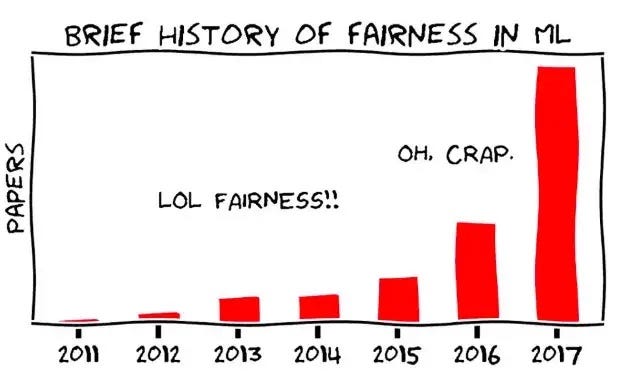
In response to the increasing complaints about Artificial Intelligence and Machine Learning (AI and ML) risks and harmes, “Responsible,” “Trustworthy,” and “Fair” have become the ultimate buzz words in the AI univers the last decade. The number of research papers and projects boomed. Big Tech companies issued reports, white papers and guidelines for their AI products. Governments and international organizations issued several recommendations and guidelines to encourage the implementation of these principles. Success criteria for AI are no longer restricted to efficiency and profit but also incorporate measurements and indicators of fairness, inclusiveness, and accountability. For instance in EuropeIn, the EU high-level expert group in Artificial intelligence emphasised — in the the ethics guidelines for trustworthy AI — the necessity of “accessibility and universal design” and the need when designing AI-based technologies to “pay particular attention to situations involving more vulnerable groups such as children, persons with disabilities and others that have historically been disadvantaged or are at risk of exclusion.”
By examining a number of academic, industrial and governmental papers and reports, it becomes clear to the reader that AI justice has three instruments, known as swords Ethics, Policy and Design. Let’s take a closer look at how these instruments can and should be used to ensure fairness and justice for persons with disability.
Ethics
Ethical scrutiny of AI in general but specifically in the context of AI for persons with disability in dierly needed. In a very simplified version Ethics play three roles: a descriptive, a normative and a guiding one. The descriptive role aims at analysing and understanding the AI “phenomenon” and describing its effects in our given context. It helps us answer questions such as “what is ableism in AI,” “why is it bad, why is it wrong,” “what is good,” “what is justice, happy life, and equality for persons with disabilities,” “what are the impacts of an ableist conceptualisation of disability in AI” and etc. The normative role aims at determining a moral (or ethically right) course of action. By answering some questions such as “how should AI be developed and what should AI be used for to reach justice for persons with disability,” “what does it practically mean for AI to be fair” etc.
The guiding role stems from applied ethics, a sub branch of ethics concerned with what AI should be obligated or permitted to do in a specific situation. Considering AI are sociotechnical systems this also imply determining what the companies (and other entities developing and using AI) should be held accountable for in case AI systems cause harm or fail to meet these moral obligations.
This first AI justice “sword” seems the instrument most used by government and international organizations (EU, UN etc.) in the form of guidelines to define what responsible and trustworthy AI should be and what risks should be avoided. This, however, has several shortcomings. First persons with disability are not often mentioned in these guidelines and when they are it is as an afterthought or as part of other “vulnerable groups.” This neither captures the specificity of this group nor helps understand and mitigate the specific risks they are exposed to when AI is used. Second, ethics language is often vague and easy to deviate from its original meaning it can and is being instrumentalised in practices of “ethical washing,” where parties such as companies or governments adopt the ethics jargon to embellish their image instead of investing in actual measures. Finally, the AI community is “young.” It does not yet have shared values, professional norms, or tools to translate these ethical principles into practices and mechanisms of accountability. So, although Ethics is a very important instrument for many reasons including the mentioned above. The current ethical guidelines are not yet inclusive for persons with disabilities and not developed enough to achieve justice for this category nor to ensure we are not developing and using harmful ableist AI. Besides, ethics should not be used by governments to substitute laws, policies or accountability mechanisms.
Policy (Laws and Regulations)
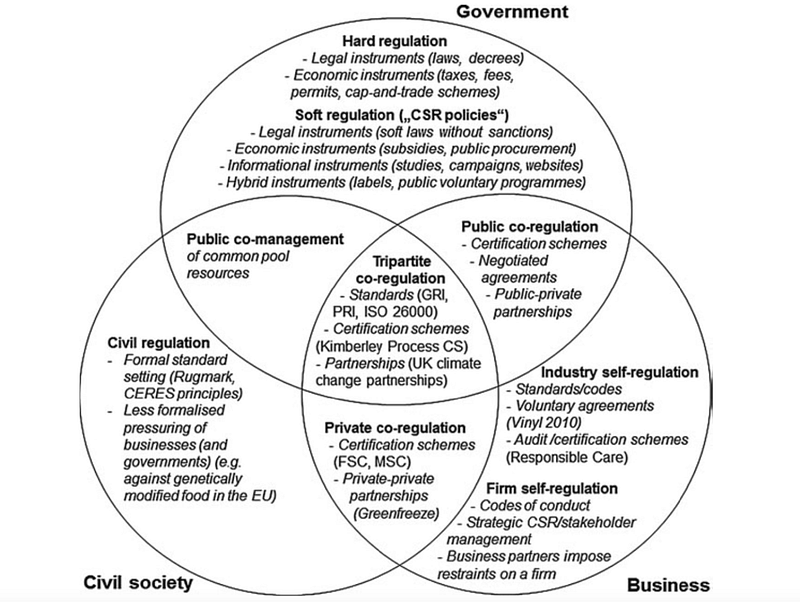
Transforming guidelines into policies and then into tangible implementation and regulation is known to be a long and tedious process in any field. It often requires deliberation among a constellation of actors with conflicting interests and priorities to reach a consensus about the content and form of implementation (through regulations or otherwise). Besides, there are numerous types of domain-specific regulations spanning from companies’ self-regulation, industrial standards, civil standards, and co-regulation to governmental “hard regulations,” each having different impacts and consequences (if you are curious about types of regulations see figure below). Implementing and evaluating regulations is, more often than not, a trial, error, and adjustment exercise.
This slow paced life cycle of policies and regulation is particularly critical in the case of AI. AI technologies are developing at a frantic pace in all fields. The regulatory frameworks (discussed in challenge 1), if and when adequately implemented, will have the potential to alleviate some issues related to existing AI products. However, the last decade taught us that the laws are not (and will not be) able to timely cope with the fast evolution of AI, as it is not possible to predict all problems that the future AI might lead to. Therefore, other measures and solutions should also be investigated, developed, and implemented to mitigate AI risks.
Design
There is a predominantly ableist “saviour narrative” in the design process of AI for persons with disability. This design narrative adoptes views of the medical, rehabilitation or charity individualistic disability models described earlier. In this narrative a person with disability is a tragic victim that needs to be cured or fixed, the tech-makers (presumably non-disabled) are the saviours, and the design is the fix and the salvation. This is problematic for obvious and less obvious reasons. I will not dwell on the obvious reasons, or maybe I will, it is ABLEISM! It can and will cause harm and violate the rights of persons with disability including agency and freedom of choice. The less obvious consequences are that it will lead to bad and useless design and products. When designers are not able to understand disability factors (and assume impairment is the only reason and cause of disability) they inevitably design products that are not adequate to fulfill the needs of a user with disability. Why should AI products be an exception? We need to shift the paradigms from “able makers” and “user with disability” to genuine collaboration. We need to empower disabled designers and design processes. And we need to educate non-disabled designers on what disability is and how it is defined in the social model as well as on effective — or, must one say — “real” co-design.
The second major challenge for designing responsible AI for persons with disability is intersectionality and the large variety of disability effects. When designing for inclusive AI technologies, designers and developers are bound to consider not only the situation of disability but also intersecting characteristics that may make some individuals with disabilities more vulnerable (or more at risk) within this same group, e.g., the person with a disability can also come from different vulnerable social backgrounds or form part of a marginalised ethnic or racial group or the LGBTQ+ community. Additionally, it is not an easy task to investigate and anticipate ways in which AI may exclude, fail, or present risks for every and all disability groups. We may not have (and might never be able to) exhaustively identified all such groups. In reality, disabilities present a “long tail” effect. Sometimes due to rare conditions, other times to unique co-occurrence of multiple disabilities, or particular combinations of contextual factors that put small groups of individuals in disability situations. In this context, one of many crucial questions is: when designing for inclusiveness and accessibility in AI, should we use approaches such as universal design and design for all, or should we make specific designs to meet specific needs and requirements?
There is still much to say but, shall we conclude?
In conclusion, if leveraged in isolation none of these “swords”/instruments will be able to achieve a responsible AI that guarantees fairness, safety for harms, and justice for persons with disabilities. In fact, in the absence of a holistic AI governing model: i) evidence-based regulations, policies, and standards for inclusive AI, ii) monitoring, assessment, and accountability mechanisms, and iii) a comprehensive strategy to design inclusive, accessible, and trustworthy AI for all, the exclusionary, discriminatory, and harmful effects of AI can only escalate and exacerbate in the coming years and overshadow the positive effects and opportunities AI can offer to persons with disability in particular and the society as a whole.
Author
Nadia Metoui is an Assistant Professor in Responsible AI, Data, and Digitalization at the Delft University of Technology in the Netherlands. Her research revolves around the topics of AI Ethics, Explainable AI and machine learning (XAI), and Privacy in the digital society. She is currently exploring the role of diverse teams and pluridisciplinarypluridiciplinary collaborations in shaping responsible human-centered AI technologies. Her teaching and supervision activities are also an important and exciting part of the job. She teaches courses about responsible, fair, and inclusive digital technologies, ML, and Data Analytics but at both masters and bachelors level.
She holds a Marie Curie-funded industrial doctorate in Data Security and Privacy. She is currently the chair of the Genders, Equity, Diversity & Inclusion working group (GEDI WG) ofat the Marie Curie Alumni Association. Within GEDI WG, she leads a team of volunteers and organize and facilitate events and actions to promote diversity and inclusion within research and academia and empower researchers irrespective of individual characteristics. She advocates for a responsible, more inclusive, and a fair research environment to foster excellence and responsible research.
About MCAA GEDI WG and ResearchAbility
Genders, Equity, Diversity and Inclusion Working Group (GEDI WG) of the Marie Curie Alumni Association (MCAA) has been active since 2014 within the association, and its primary goal is to promote diversity in research and empower research, irrespective of any individual characteristics. We organize and take part in actions and events to investigate and raise awareness around inequalities and challenges of diverse and historically marginalized researchers. We also advise and develop solutions to boost equity and diversity at Individual, Institutional, and Policy levels.
ResearchAbility (RA) is a Task Force with MCAA GEDI WG. The main mission of RA is two-fold: firstly to support the careers of students and researchers with disabilities and secondly to promote research and awareness on disability and inclusive culture in the academic environment


