Future Forward: Careers, Collaboration, and a Spark of Innovation
by Polat Goktas
During the MCAA Annual Conference 2025, the Communication Working Group organised a blogging contest, inviting onsite and online participants to share key takeaways, insights, and reflections through engaging blog posts. This contest encouraged participants to engage deeply with various sessions and topics, providing a platform for sharing diverse perspectives and highlighting key moments from the event. After receiving several submissions, the top entries, showcasing exceptional quality and reporting, were published and honoured with awards. The blog post below earned first place in the blogging contest.
--
“How do we bridge careers, collaboration, and innovation for the future of science?”
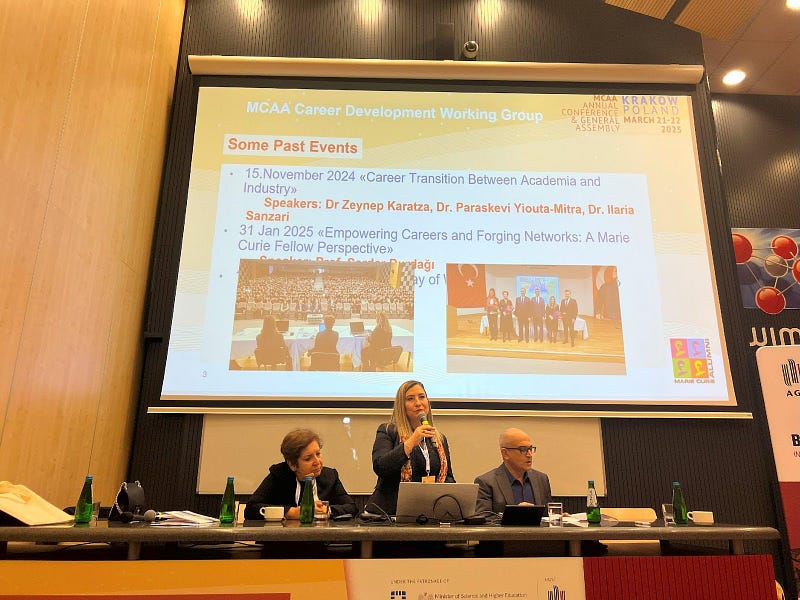
This was the question that resonated through the grand hall in Krakow, Poland, on March 22, 2025, during one of the most energizing sessions of the 2025 MCAA Annual Conference and General Assembly: “The Future of Science: Bridging Careers, Collaboration & Innovation.”
Organized by the Career Development Working Group (WG), the session was not just another event — it felt like a collective reawakening of how we imagine scientific careers in a changing world.
Sureyya Akyuz, Chair of the Career Development WG, opened the session with a thoughtful, forward-looking speech that immediately captured the room. She didn’t just talk about career development in abstract terms — she framed it around three vital pillars:
- Career Fluidity — enabling researchers to move freely between academia, industry, and policymaking without stigma,
- Collaborative Science — dismantling silos and encouraging interdisciplinary and intersectoral work,
- Sustainable Career Development — aligning personal career growth with broader societal needs, such as the UN Sustainable Development Goals (SDGs).
Her words set the tone: the future of science isn’t about rigid paths but about adaptable, collaborative, impact-driven journeys. Sureyya also highlighted the role of the Marie Skłodowska-Curie Actions (MSCA) in fostering mobility and systemic change, urging researchers to imagine science as an open, evolving ecosystem.
From there, the session flowed into a powerful talk by Aytul Ercil, Co-founder and CEO of Vispera. Aytul’s story was as inspiring as it was instructive. With a background in academic research in computer vision, she made the bold leap into entrepreneurship, co-founding a company that now delivers AI-powered retail solutions globally.
Her message was crystal clear: Innovation does not happen in isolation. It happens when researchers dare to bring their ideas beyond academic journals and into real-world applications.
She shared real examples — like how AI-based visual analytics can transform inventory management — and spoke candidly about the challenges of scaling deep-tech startups, securing funding, and building teams that blend visionary thinking with technical excellence. Importantly, she also addressed the ongoing need for gender inclusion in tech entrepreneurship, stressing that sustainable innovation must be inclusive by design.
One line from her talk stayed with me: “Sustainable innovation demands collaborative environments where ideas can be tested, refined, and scaled for real-world benefit.” It was a rallying cry for researchers to think not only like scientists but also like solution-builders.
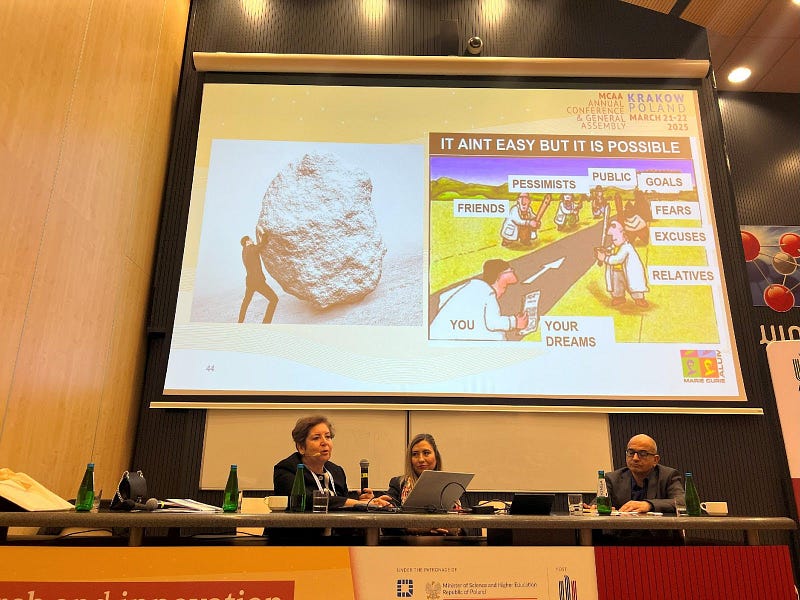
Following her, Sohail Saad Luka, Policy Officer from the European Commission’s MSCA Unit, offered a compelling vision of how industrial doctorates are reshaping research careers. MSCA Industrial PhDs, he argued, are not a compromise — they are a dynamic hybrid model that empowers researchers to thrive at the intersection of theory and application.
Sohail’s talk detailed how the dual supervision model of industrial PhDs — academic and industrial — enriches the doctoral experience, ensuring relevance to both scientific excellence and real-world innovation needs. He called attention to institutional frameworks like MSCA COFUND and EIT Knowledge and Innovation Communities that scaffold these programs, emphasizing how they help researchers acquire multi-sectoral fluency.
One particularly resonant point was his advocacy for competency-based evaluation rather than judging doctoral success purely by publication counts.
Sohail’s vision painted a future where researchers are seen not only as scholars but as active agents of change in society’s most pressing challenges.
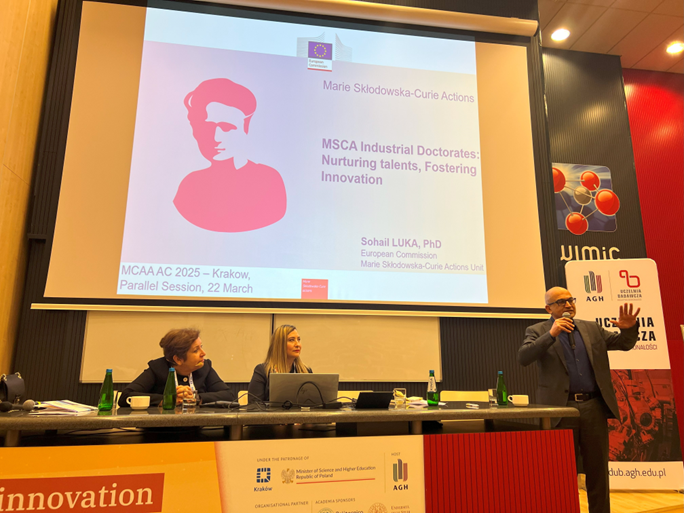
The session’s momentum continued with the virtual intervention of Keti Zeka, who dialed in to share her cross-disciplinary perspective on HealthTech, AI, and entrepreneurial science. Keti spoke with a kind of contagious energy, illustrating how AI is rapidly transforming healthcare — from predictive analytics to personalized medicine — and opening up new pathways for scientific entrepreneurship.
However, she also offered important cautions: Barriers like data privacy issues, algorithmic bias, and the complexities of integrating AI into legacy healthcare systems must be tackled head-on, with ethical, human-centered designs.
Drawing from her entrepreneurial journey, she emphasized that building a HealthTech startup demands not just scientific excellence but also resilience in navigating regulatory landscapes and clinical validation hurdles.
Perhaps the most memorable takeaway from Keti’s talk was her call for mentoring underrepresented groups in STEM. “Innovation thrives when diverse voices shape the conversation,” she reminded us, highlighting that diversity and inclusion are not side issues — they are central to building the future of science.
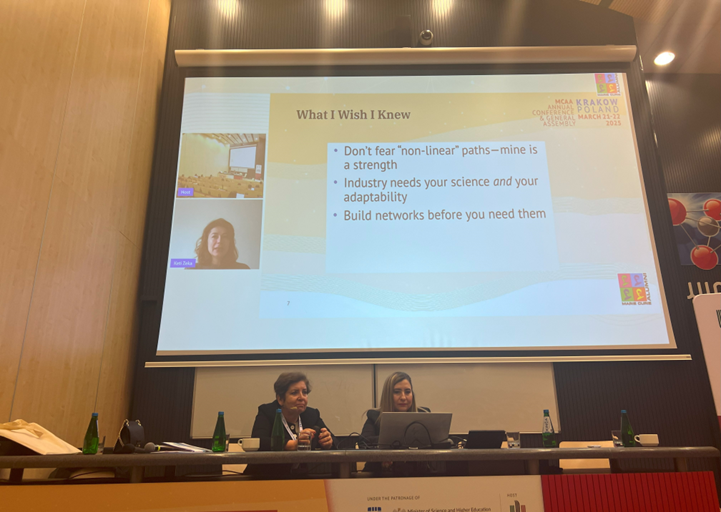
As the formal presentations ended, Sureyya Akyuz seamlessly transitioned into a lively, interactive reflection session, inviting attendees to share their insights and aspirations.
Live polls and open discussions revealed an overwhelming appetite for intersectoral careers, blending academia with industry, policy, and entrepreneurship. Participants identified key barriers — limited mentorship opportunities, fragmented funding ecosystems, and entrenched academic cultures resistant to change.
A recurring theme that emerged from the reflections was the importance of soft skills: Communication, digital literacy, project management, and networking were cited as critical tools that researchers must cultivate alongside technical expertise to thrive in the future landscape.
One participant captured the spirit of the session perfectly:
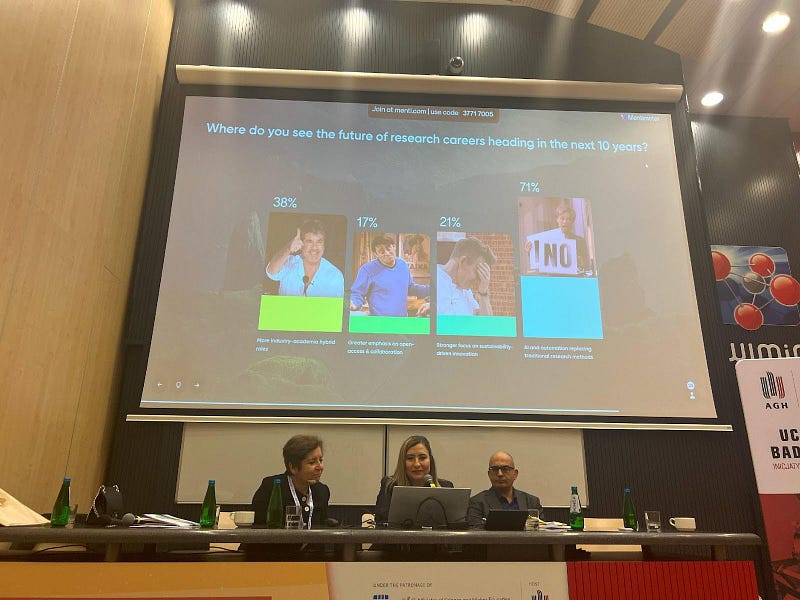
In closing, Sureyya reaffirmed that career development in science is not a linear, one-size-fits-all journey. It is dynamic, shaped by creativity, collaboration, and the courage to step beyond traditional boundaries.
Reflecting on the session, I left with a renewed sense of excitement, and responsibility. The future of science belongs to those who dare to bridge disciplines, sectors, and communities. It belongs to those who are willing to step outside their comfort zones, collaborate boldly, and innovate ethically.
The next chapter of scientific careers isn’t being written inside ivory towers. It is being written in the bridges we build, the partnerships we forge, and the innovations we dare to imagine.