Graphic Novels Boost Children’s Engagement and Performance

Graphic novels have cemented their place in libraries as powerful educational tools in the classroom. Well-loved by all children, they serve as the great equalizer in the classroom as both uncertain, and enthusiastic readers enjoy reading them. They help dyslexic children, autistic children, and reluctant readers understand the story with visual cues and emotions.
The visual aids accompanying the storyline serve as a bridge between beginner and advanced readers and leads to increased group discussions among students of all ages and varied reading levels.
For children who learn visually, graphic novels have improved their engagement levels in the classroom, and this art-filled format is perfect for all types of learners. Visual, verbal, logical, interpersonal, intrapersonal, naturalistic, and rhythmic learners all benefit from the design, formatting, pace of sequential illustrations, characters’ facial expressions, and repetitions of set backgrounds in graphic novels.

Graphic novels have a feeling of play associated with them — instead of a more traditional method of learning — and children are more eager to participate. For the unengaged and reluctant reader, reading through an all-text book feels like drudgery whereas flipping through a story filled with illustrations feels like a treat. Literacy is best accomplished when the reader is interested and absorbed in the story.
With kids spending more than six hours a day looking at screens, there is no argument that their worlds are visual. By embracing the popularity of comics, teachers and parents can create instructional strategies that promote more enthusiastic readers.
For families looking to limit their children’s screen time at night, graphic novels present the perfect solution for the kid who needs a visual story and the parent who wants to increase exposure to books. The media within the books are expressive, engaging, and suitable for all literacy and learning abilities and leads to increased vocabulary and comprehension of complex situations and conflicts.
Storytelling with minimal words on the page, or no words at all, allows the illustrations to serve as a visual platform to aid young readers. Many of the classic stories like Frankenstein and Little Women have been remade as graphic novels to appeal to a broader audience.

Karla Valenti and Annalisa Beghelli, the writer and illustrator of the first book in the My Super Science Heroes series, felt that the graphic novel format was the perfect way to illustrate the complex concepts and scientific discoveries of historical figures for young children. Marie Curie and the Power of Persistence, the first book in the series, doesn’t attempt to retell her biography in the usual way. Marie faced institutional sexism, poverty, and intense competition from fellow scientists in her field — all concepts that are much too large and overwhelming for young kids to understand.
Instead of retelling Marie’s biography, Marie Curie and the Power of Persistence presents her life’s story and historic achievements in chemistry in physics in a graphic way that spurs the imaginations of the readers and helps them connect the series of events in her life. By presenting her achievements visually, kids can understand that Marie worked hard to overcome challenges time and time again in various ways.
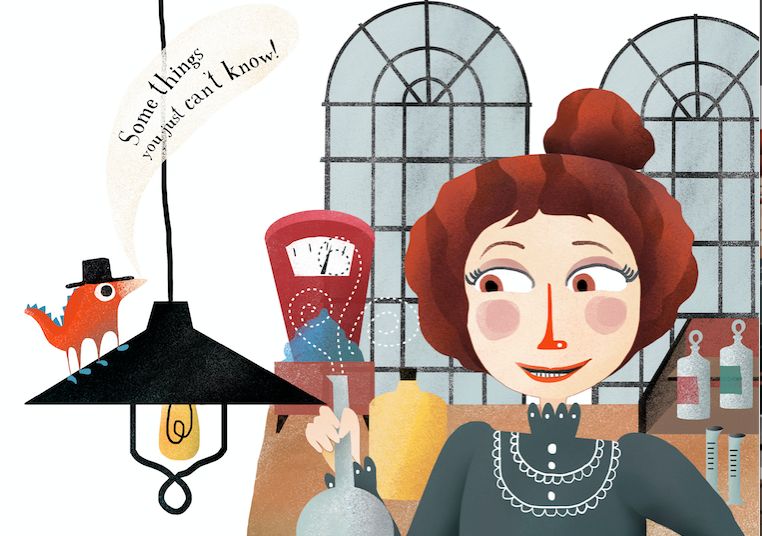
Marie’s encounters with numerous obstacles in her life are represented by the character, Mr. Opposition. He follows her wherever she goes and is an unrelenting presence throughout all stages of life. Mr. Opposition is often hidden in some of the images, and the children must look for his figure peeking out from various hiding places.
Reading the book together as a family or a classroom is a developmentally healthy activity that can lead to robust and spirited conversations about overcoming challenges both big and small.
Here are some ways in which you can use Marie Curie and the Power of Persistence to teach writing in your class or at home:
1 — Have the children draw an image (or images) that illustrates the concept of persistence. What challenge does their main character need to overcome to be successful?
2 — Ask your students to choose one page of the book that is their favorite and write a story that matches the illustration. What aspects of the illustration do they want to highlight in their version of the story?
3 — What role did Mr. Opposition play in Marie’s life? Ask your students to discuss a time when they had to overcome their own Mr. Opposition.
Pre-order Marie Curie and the Power of Persistence today for your home or classroom and help children learn that they can overcome any challenge they face no matter how large. Click here to support the project today before time runs out on July 4.