How accessible is science communication really?
By Luisa Merz
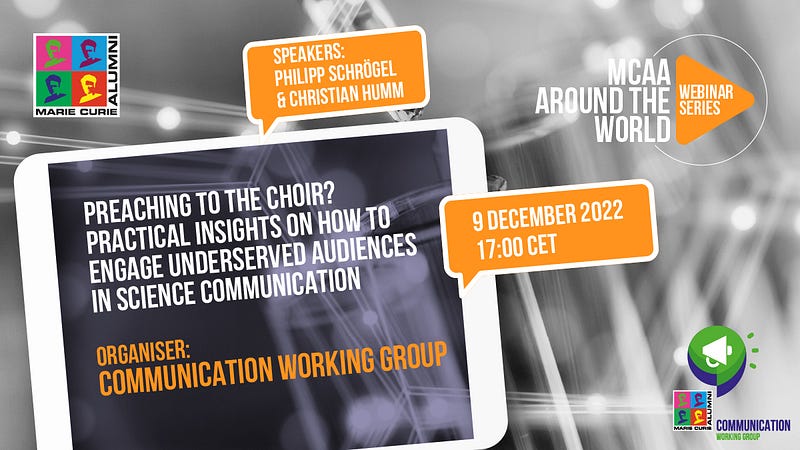
The MCAA has initiated a series of webinars that run each second Friday of the month starting in December 2021. The aim is to provide educational webinars to the MCAA members and non-members as a way to thank them for the support received all these years.
The 12th episode, organised by the Communication Working Group, deals with the topic of science communication and whether it actually reaches all audiences. The recording is available and can be watched on the MCAA YouTube channel.
The speakers of this webinar titled “Preaching to the choir? — Insights into how to engage underserved audiences in science communication” are Christian Humm from Saarland University, Germany, and Philipp Schrögel from Heidelberg University and the Centre for Apocalyptic and Post-Apocalyptic Studies (CAPAS), Germany.
Science communication events are often planned to appeal to people outside of academia. However, the typical audience during these events is mainly made up of older, well-educated people. Studies by the speakers show that the vast majority (>70 %) during popular science lectures are made up of people in the age group 60 and older with over 50 % of visitors holding a university degree, many a Ph.D. This raises the question:
The problem of course is not that scientists come to those events, but rather that others don’t. The speakers of this webinar explored the reasons for this further. A growing number of studies was found investigating exclusion in science communication in recent years, which showed a general lack of a systematic approach regarding exclusion causes.
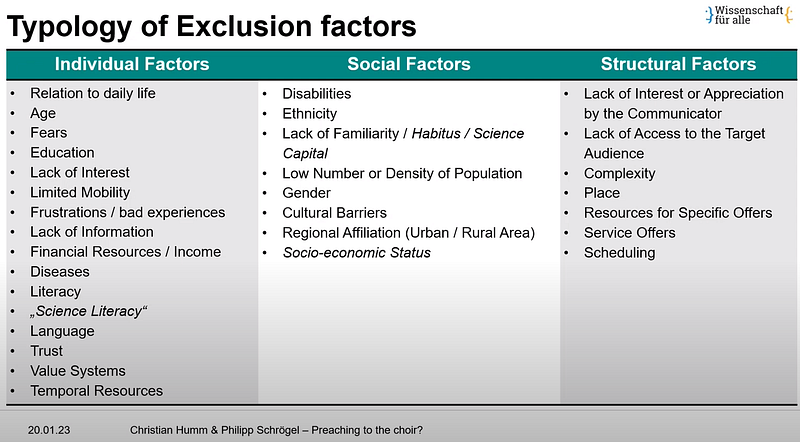
In their project “Wissenschaft für alle” (Science for all) the speakers addressed the issue and found 31 exclusion factors that prevent people from participating in science communication events. These factors could be divided into three main categories:
-
Individual Factors
Individual factors such as age, education, lack of interest, financial resources, bad experiences, or lack of trust prevent an individual from participating in science communication. -
Social Factors
Lack of familiarity, cultural barriers, disabilities, or low density of population are all social factors that can exclude certain groups from science. -
Structural Factors
From the organiser’s side, factors such as scheduling, place, complexity or service offers can hinder people from participating in science communication events.
The speakers practised as they preached and turned the 31 exclusion factors into a comic to make the problem visually appealing and accessible. The comic can be found here.
Christian showed that science accessibility is not just a moral issue, but the data shows that a wide mix of unrelated factors such as age, gender, religion, or ethnicity influence the public view on science-related issues such as vaccines or animal testing, and their behaviour towards those topics.
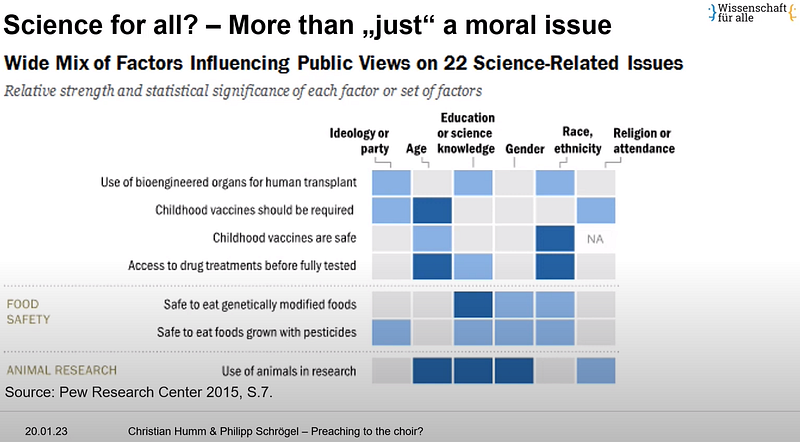
A representative survey was taken that showed a connection between exclusion factors and indicators such as visits to public lectures or an interest in science. Statistical analysis shows that proximity to science is a strong explanatory factor, education, age, gender, and income are significant for some indicators and interestingly, migration background and religiousness are only seldom significant for the indicators in the survey.
Three case studies with underrepresented audiences revealed that several exclusion factors played a role as to why these groups did not participate in science. Time was mentioned as an important factor as a full-time job and other responsibilities do not leave much time for science. The disinterest of communicators was also criticised as these events often take place at universities or higher education schools, but rarely at lower secondary schools or youth centres. Lastly, a difference in class between the group and the scientists was perceived, with one participant saying “Scientists are cleverer than we are.” All three case studies showed that the study participants are interested in science, but hardly consumed any science communication. The reasons could be divided into material factors such as lack of infrastructure, financial and time resources or language barriers and emotional factors such as fear (e.g. of sounding stupid) and frustration, emotional and habitual distance, and self- and external perception. The results of the study can be found here.
The speakers finished their talk with 7 practical recommendations for science communicators:
- Start with listening. Actually listen to the interests of your target audience
- Reduce distance and be accessible. Use easier language to be more approachable. Do not forget about disabilities such as blindness or learning disabilities. Always add an image description when using images.
- Be relevant for everyday life. Find a connection to your audience, the scientific topic should be relevant for their everyday problems.
- Go where people are. Instead of staying at universities for science communication events, go to city quarters or youth clubs where you will easily meet your target audience.
- Cooperation is key. Cooperate with local associations and groups who know the target audience and have gained trust from them.
- Mind the “openness paradox.” Scientists tend to leave topics up for debate and want to encourage active participation. It is well-meaning to try to not educate people, but to include them in the discussion. This however might not be beneficial. People might not have a clear image of science and have no personal relation to science and research and may not know the topic very well and are therefore often reluctant to say something and participate in open discussions.
- Implement long-term activities. This will build trust and have a long-lasting impact. Without regular or follow-up events, people might feel disappointed and the science communication event will not have an impact.
Some ideas for the practical implementation from the speakers’ own experience are:
- Organisation of a research rally in the afternoon next to a primary school where stations from museums and university prepared team tasks for children and parents.
- Organisation of a science and poetry slam in a youth club in the evening with a mix of poetry and science slammers.
- Encourage social media influencers to talk about a topic that they are interested in and produce content about it to publish on their social media channels [Example by German influencer (only available in German)].
- Organisation of events in rural areas. Go back to rural home regions and villages and talk at local bars or sports clubs.
- Combining game or movie nights with thematic presentations or commentary, for example, showing a movie about artificial intelligence and inviting a guest speaker to talk about AI or having game night with games about apocalypse and short presentations by apocalypse experts.
About the Author
Luisa Merz is a PhD student at KTH Royal Institute of Technology in Stockholm as part of the Marie-Curie Action INTERfaces. There she is working on the sustainable production of amines using biocatalysis. In addition to science communication, she is passionate about green chemistry and tea.