International Day of Persons with Disabilities: Disability, Technoableism, and the Three Swords of AI Justice
by Nadia Metoui
Please note this is the first part. Part 2 will be published on the 9th of December and will focus on “Disability and the Three Swords of AI Justice.”
Progress in digital technologies during the last three decades gave a positive push to diversity and inclusion, enabling cultural change towards the creation of a feeling of belonging for many minority groups. Information and communication technologies (ICT), for example, have been enabling communities to form, connect and empower their members across multiple borders (physical and attitudinal). Social media provide the opportunity to voice minorities, giving them the possibility to create and disseminate news and content that mainstream media did not, and oftentimes still do not promote. Conferencing and remote working tools have been breaking down or lowering many barriers (reducing the situation of disability) for persons with impairments, participation limitations, chronic diseases, and chronic disorders, enabling them to join the workforce.
As one of the newest technological trends, artificial intelligence (AI) and machine learning (ML) have the potential to do more and help us develop truly inclusive workplaces and societies. They can even push the boundaries of the possible and augment the abilities of everyone, not only people with disabilities.
There are, however, several traps to presenting AI technologies (or any other technology) as the ultimate solution to “Each,” “Every,” and “All” issues and challenges around accessibility, inclusion and justice for persons with disability.
What is disability?
Disability Models, and Disability Creation Process
Before diving head-first and enumerating issues and shortcomings of AI Technologies, let’s explore some ground — and as one might say — ground-breaking understanding of Disability. So what is disability? The answer is not as straightforward, it depends on the model one adopts to define disability. As hinted to above, there are several conceptions or models of disability; these different models can be classified into two categories.
The Individualistic category:
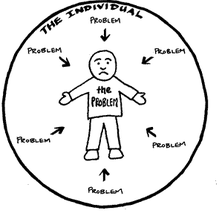
This category of disability models considers disability as a ‘deficit’, ‘defect,’ or ‘abnormality’ found in the body and/or mind of disabled individuals that make them ‘unfit.’ Therefore, this deficit is considered an issue of the individual — that ‘others’ need to ‘fix’ — for the disabled individual to have a ‘normal life’. From a societal perspective disability (and disabled individuals) is then either considered a burden and inconvenience that needs to be ‘irradicated’ or ‘hidden’ so ‘all’ can live in a normal society or considered a ‘tragedy’ for ‘others’ and the society to be charitable towards. The most common individualistic category is the medical model of disability. Disability is perceived as a disease or a medical condition that should be cured. A person with some disability is considered a “disabled person.” Medical staff, experts and researchers (often “non-disabled”) hold the knowledge about the “disability” and the decision power over its cure. The knowledge and experience of the person with a disability are often disregarded in this model. Two very similar models are the rehabilitation model and the charity model. The former aims to minimize the presence of disability in society. The latter labels the disability as a “tragedy” and some “disabled persons” as deserving of charity.
Although individualistic disability model approaches seem benevolent, they can be very ableist and detrimental to persons with disability. They reinforce the idea that the person with disability is “a problem.” The medical model and rehabilitation model are authoritative. They infantilize persons with disabilities, seldom “believe” their experiences or that they might know what is better for themselves, and very often disregards their right to agency and freedom of choice. This can lead to horrible and unethical practices, such as isolation and internment, forced sterilization etc. The charity model can additionally create segregation between categories of persons with disabilities and declare some of them “real” and “worthy of help” and others “not real” and “unworthy”…
The social category:
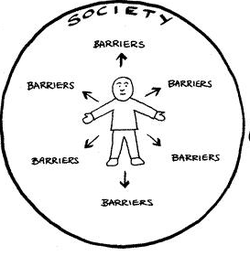
This category perceives disability as a social construct. “Disability and Functioning” in this category are contextual consequences of a given environment (for example, social attitudes, architectural characteristics, legal and social structures, as well as climate, terrain and so forth); impairments (commonly used in a medical sense, can be caused by diseases, disorders, injuries etc.), and internal personal factors (including gender, age, social background, education, profession, past and current experience etc.). So, in this category, there is a distinction between impairment and disability. Impairment refers to the “individual” state, which may or may not impact the ability of a person to participate in society. Disability, however, is a socio-cultural judgment imposed upon an individual’s abilities by their society. A person who cannot see in the dark is not considered disabled. Not seeing in the dark is socially considered “normal.” A person having a missing or incompletely formed limb is often considered “abnormal,” so even if they are perfectly able to walk are labelled as the social perception of what is “normal walking” would consider them “disabled.” Therefore changing social perceptions is what alleviates the situation of disability in this case. Social models of disability consider alleviating situations of disability and lower barriers facing persons with disability as a social responsibility.
Good to know! But What does all this have to do with AI?
Techno-solutionism and Techno-ableism
There are many risks associated with the use of AI. AI biases, including racism, misogyny, safety, and security threats, did not stop making the news headlines this last decade. In particular, people with disabilities are often targeted by discrimination when AI is used in fields such as health (insurance policies, treatment priority, etc.), school and university admission, job recruitment, job performance evaluation, social media, transportation and mobility etc. Discriminations against persons with disability is sometimes referred to as ableism. Like other forms of discrimination ableism can also be indirect, unintentional or covered behind a veil of impartiality or benevolence. This can be both on individual levels (e.g., ableist behaviour) and on structural (e.g., ableist policies, ableist design). Ableism can also be driven by problematic beliefs and understanding of disability similar to the ones explained in the individualistic disability models.
AI, similarly to any other technology, is the product and reflection of the society we live (and we lived) in. It is influenced by political, economic and organisational decisions made in the past, and it inherits (and it turns out it amplifies) the shortcomings and biases of its environment. AI Techno-ableism happens when we allow ableist narratives (and practices) about persons with disability to shape our digital and technological imaginations. AI can be techno-ableist in several ways. We mentioned above the example of exclusion and discrimination against persons with disability in several fieleds. These unfairnesses add to the already social and economic precarity historically imposed upon these individuals in the so-called offline world. Furthermore, the efficiency, inclusiveness, security, and safety of AI products have raised many controversies, especially when these AI are developed without the participation or involvement of users and tech-makers with disabilities.
Another form is techno-ableism through techno-solutionism. Techno-solutionism is the idea that technology (AI in this context) can and should be used to solve all societal problems. In the context of persons with disability, AI techno-solutionism often comes disguised as “empowering disabled people through technologies” while at the same time abiding by the same ableist ideas and practices, namely, the need to “fix” persons with disability for them to “fit” the normal world. Besides, techno-solutionism is often the tree hiding a forest of “profit-driven” issues. The AI industry has become notorious for prioritising profit, over-promising, under-delivering and hiding or disregarding safety and reliability issues. In the context of disability this will breed at best expensive disappointing products and at worst harmful and live threatening ones.
There is no doubt that AI is here to stay. On one hand AI is a powerful technology that can do so much to help us understand and improve ourselves, our world and our societies. On the other hand, AI products are disruptive and versatile; they bear risks that are hard to predict, can scale up rapidly and have devastating impacts in excluding, alienating, and harming vulnerable groups, including people with disabilities. The choice we are left with is no more about whether to use AI or not. It is, instead, what kind of AI do we want. The one that infantilizes, excludes, and hams historically marginalized groups. Or the one that includes, empowers, and protects all members of the society, including persons with impairments, activity limitations, and participation restrictions — people with disabilities?
Author

Nadia Metoui is an Assistant Professor in Responsible AI, Data, and Digitalization at the Delft University of Technology in the Netherlands. Her research revolves around the topics of AI Ethics, Explainable AI and machine learning (XAI), and Privacy in the digital society. She is currently exploring the role of diverse teams and pluridisciplinarypluridiciplinary collaborations in shaping responsible human-centered AI technologies. Her teaching and supervision activities are also an important and exciting part of the job. She teaches courses about responsible, fair, and inclusive digital technologies, ML, and Data Analytics but at both masters and bachelors level.
She holds a Marie Curie-funded industrial doctorate in Data Security and Privacy. She is currently the chair of the Genders, Equity, Diversity & Inclusion working group (GEDI WG) ofat the Marie Curie Alumni Association. Within GEDI WG, she leads a team of volunteers and organize and facilitate events and actions to promote diversity and inclusion within research and academia and empower researchers irrespective of individual characteristics. She advocates for a responsible, more inclusive, and a fair research environment to foster excellence and responsible research.
About MCAA GEDI WG and ResearchAbility
Genders, Equity, Diversity and Inclusion Working Group (GEDI WG) of the Marie Curie Alumni Association (MCAA) has been active since 2014 within the association, and its primary goal is to promote diversity in research and empower research, irrespective of any individual characteristics. We organize and take part in actions and events to investigate and raise awareness around inequalities and challenges of diverse and historically marginalized researchers. We also advise and develop solutions to boost equity and diversity at Individual, Institutional, and Policy levels.
ResearchAbility (RA) is a Task Force with MCAA GEDI WG. The main mission of RA is two-fold: firstly to support the careers of students and researchers with disabilities and secondly to promote research and awareness on disability and inclusive culture in the academic environment


