Meet the Fellow awarded four Marie Skłodowska-Curie Actions!
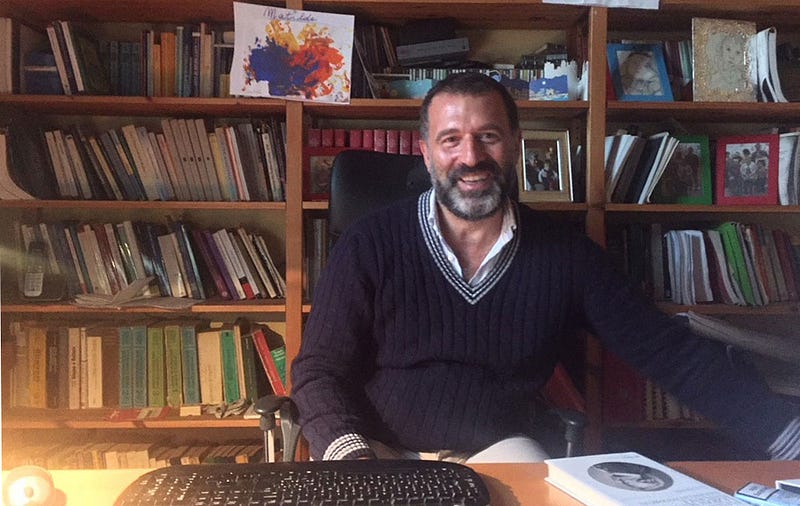
This post proves how determination can be rewarded. Luigi Caranti is a Marie Curie Fellow who has been awarded every possible type of Marie Skłodowska-Curie Action! The latest was a Research and Innovation Staff Exchanges (RISE) grant. We met him to determine the secret to so many successful applications.
Luigi is an Associate Professor of Political Philosophy at the Università di Catania. He is a Kant specialist who enjoys making Kant relevant to our current societal and political problems. From this perspective, he has worked and he is still working on human rights.
His current project is called “Kant in South America”.
“It is about the very interesting results that the South American Kant scholarship has obtained in the last two decades, corresponding to an increased interest in Kant there and an even more impressive increase in quality of research in those academic areas. We are four European universities (UNICT — coordinator, LSE, MLU, UNILIS) and four South American institutions, two Brazilian and two Argentinian (UFSC, UFMG, UNIBA, CONICET). The project will involve more than 40 researchers and will last four years.”
Six things that Luigi learned when applying for an MSCA

1. Be determined
Determination is the number one requirement for a successful application, says our Fellow. “I had a well-defined scientific interest in my mind, a need for better treatment of my work, plus I and wanted to pursue my plans in the most efficient ways. All three MC grants arose from this motivation.” For those who would like to question him directly, he offers free seminars in his capacity as Marie Curie Ambassador.
2. Network your way to a RISE grant
Luigi had begun launching a network that was largely in place when intuition told him that this was the ideal starting point for a RISE application. Building the network wasn’t so complicated: “Most of us Europeans had been regularly invited to give lectures in Brazil or Argentina,” he says. His tip for a successful RISE application is simple: “Use your existing contacts and professional relations or even better an existing network. This makes the application easier and tends to be well received by referees.”
3. A Global Fellowship is a gateway to the world!
When asked about his favourite MSCA, Luigi answers without hesitation that his Individual Fellowship ticked all the boxes:
4. Failure is part of the process

You shouldn’t be afraid to fail in your application! Luigi confessed that he failed once for each grant he received, but that these experiences helped him write a very strong RISE proposal — it was accepted at the first attempt! “I learnt how to make my proposal more effective for the next call.” Confidence and self-belief are also crucial: “Referees’ suggestions need to be viewed critically. Some suggestions are not very helpful or profound and it may be better to ignore them.”
5. Choose your partners carefully
Even for Individual Fellowships, the importance of partners cannot be over-estimated. “The fit between my proposal and the quality of the receiving institution has always been positively evaluated,” says Luigi.
6. Timing, impact and implementation
Before applying for a new grant, take note of Luigi’s final tip. “Start at least a couple of months before, be bold and clear in showing that your project is important from a scientific point of view. Do not underestimate Impact and Implementation as even the best scientific idea won’t be funded if you do not pay attention to those two sections. In addition, do a double review (a draft submitted to knowledgeable colleagues and to national contacts points — they usually do reviews).”
What’s next?
A European Research Council (ERC) grant is one of the few grants that have so far eluded Luigi — his first proposal was rejected at the second stage. But our Fellow intends to apply again next year for a Consolidator grant. We wish him the best of luck!
Are you inspired by this story? Keep on reading and find out what is on offer from the Marie Skłodowska-Curie Actions (MSCA) for talented researchers!
Since 1996, the MSCA have featured in numerous success stories by supporting over 100,000 researchers: 80,000 before 2014, and more than 20,000 so far under Horizon 2020. From 2014 until 2020, with a budget of EUR 6.2 billion, the MCSA are expected to support around 65,000 researchers, including 25,000 PhD candidates.
1. Are you a young researcher? Apply for an Innovative Training Networks (ITN) grant
These support young researchers with doctoral-level training within and outside academia. Organisations such as universities, research centres and companies are the beneficiaries, but they must have a research training network. Individuals can apply for specific positions within these networks, as advertised on Euraxess.
ITNs are further divided into three categories (Please note that the figures apply to successful consortia and not to individual researchers):
- European Training Networks (success rate of 7.6% in 2015 and 6.8% in 2017);
- European Industrial Doctorates (success rate of 13.4% in 2015 and 10.5% in 2017);
- European Joint Doctorates (success rate of 11.5% in 2015 and 10.5% in 2017).
The maximum duration of an ITN project is four years.
2. Are you an experienced researcher? Go for an Individual fellowships (IF) grant
IFs support experienced researchers moving between countries and offer the option of working outside of academia. The grant is awarded to a host organisation, usually a university, research centre or company in Europe. The research costs and overheads of the host organisation(s) are also covered.
From 2015 to 2016, 56% of those receiving an IF were male, and 44% were female. There are two types of IF:
- European Fellowship (EF) (2014–2016 application success rate: 15.3%)
- Global Fellowship (GF) (2014–2016 success rate: 11.9%).
The top three countries for the outgoing phase of the GF are the United States, Canada and Australia.
European Fellowships usually last from one to two years, whereas Global Fellowships can last from two to three years.
3. Are you looking for a short-term exchange for your staff? Opt for a Research and Innovation Staff Exchanges (RISE) grant
These exchanges support both international and inter-sectoral cooperation. This action targets universities, research centres or companies who welcome the opportunity for their staff to take up a one month to one year secondment.
Proposals should include at least three partners (which can be universities, research institutions, or non-academic organisations) from three different countries. At least two of these should be from the EU or associated countries.
The overall proposal success rate was 23% in 2016 (Please note that the figures apply to successful consortia and not to individual researchers).
4. Do you work for an organisation that funds or manages doctoral programmes or fellowship programmes for researchers? Apply for Co-funding
Regional, national and international programmes financing research training or fellowships involving mobility to or from another country can be financed through co-funding. Organisations funding or managing doctoral or fellowship programmes for researchers are the beneficiaries. These could include a government ministry, regional authority, funding agency, university, research organisation, research academy or enterprise. Each project has a sole participant.
The proposal success rate rose to 29.7% in 2016 (Please note that the figures apply to successful consortia and not to individual researchers).
Selected programmes receive co-funding for three to five years.
Follow us on Medium
This post was written by Aurélia Chaise
Have any comments on this story? Make sure you share them, using the comment form below.
Useful links
EU gives a thousand researchers a flying start to their careers
Statistics — Marie Skłodowska-Curie actions research fellowships
MSCA — 20 years of European support for researchers’ work [pdf]
IF Statistics [pdf]
ITN Statistics [1] [pdf]
ITN Statistics [2] [pdf]
RISE Statistics [pdf]
COFUND Statistics [download/pdf]