Narrative CV — The What, How and Why
by Luisa Merz
During the MCAA Annual Conference 2024, the Communications Working Group organized an exciting blogging contest. Participants were invited to write insightful blogs covering various sessions throughout the conference and capturing key insights. After receiving several compelling entries, the best entries, showcasing exceptional quality and reporting, were published and honoured with awards. This contest not only encouraged attendees to engage deeply with the conference content but also provided a platform for sharing diverse perspectives and highlights from the event. This initiative fostered active participation and highlighted the conference’s rich array of topics.
--
The Status-QuoThe Status-Quo
Anyone applying for funding, grants, or jobs knows the struggle. You have dedicated yourself to your research, provided mentorship to students, diligently peer-reviewed articles, volunteered, kept the lab running, helped set up that new machine and spent months trying to get a new experiment going, only to fail again and again, and yet still persevered. Unfortunately, most of these efforts go unnoticed in your application. Research evaluation is often done based on a small amount of quantitative criteria like the number of publications and the impact factor of the journals you have published in, or the number of patents you hold. Consequently, researchers have adapted to these criteria and started prioritizing output above all else. Other activities that will not be rewarded are seen as a waste of time.
However, the speakers of this session have a shared vision: that diversity and success are recognized, that criteria like process development, peer review, outreach, openness, collaborative efforts, and an emphasis on quality over quantity are valued and actively rewarded. Here, a narrative CV can be a way of highlighting those often-overlooked achievements, allowing individuals to reveal their contributions to the scientific community beyond simple numerical metrics.
What is a narrative CV?
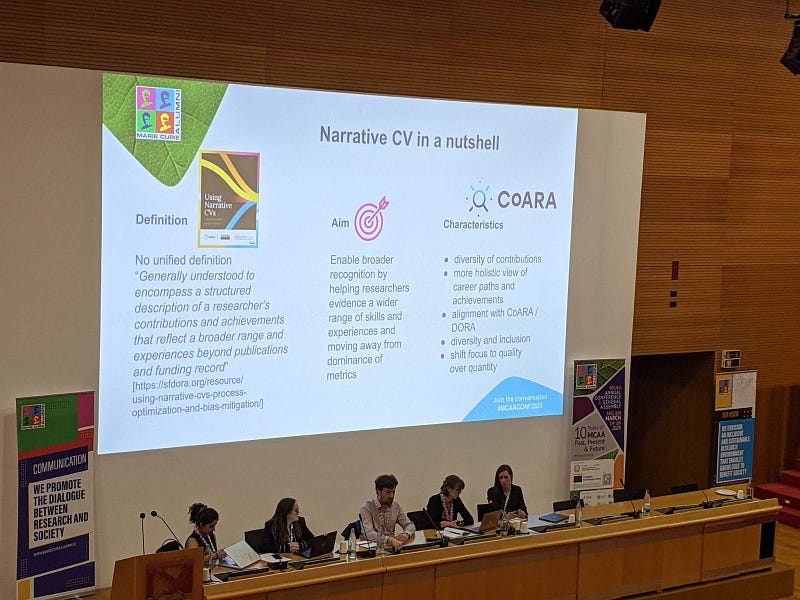
Although there is no unified definition of what a narrative CV is, it can be understood as a structured description of a researcher’s diverse contributions and accomplishments, demonstrating skills and experiences beyond mere publication and funding records. Unlike a traditional CV, which primarily emphasizes what the person has achieved, the focus is shifted to how. It allows for a wider range of skills and experiences to be showcased, incorporating a mix of qualitative and quantitative qualifications. A narrative CV leaves room to reflect on the researchers’ contributions, and claims made in a traditional CV are more substantiated with concrete examples of the researchers’ work.What is a narrative CV?
Why you should write a narrative CV
Writing a narrative CV takes more time and more work and is oftentimes not required, so why go through the effort of creating one? Well, instead of following a strict template, it gives you the space to express yourself and create a distinct profile. A narrative CV allows you to showcase your skills and accomplishments that you have worked so hard for.
Reviewers report that reading a narrative CV was useful in their evaluation process and the majority of reviewers agree that it is important to show a broader range of skills compared to traditional CVs. Last but not least, narrative CVs are being increasingly adopted by funding agencies, which are recognizing that the current form of evaluation is inadequate.
How do you write a narrative CV?
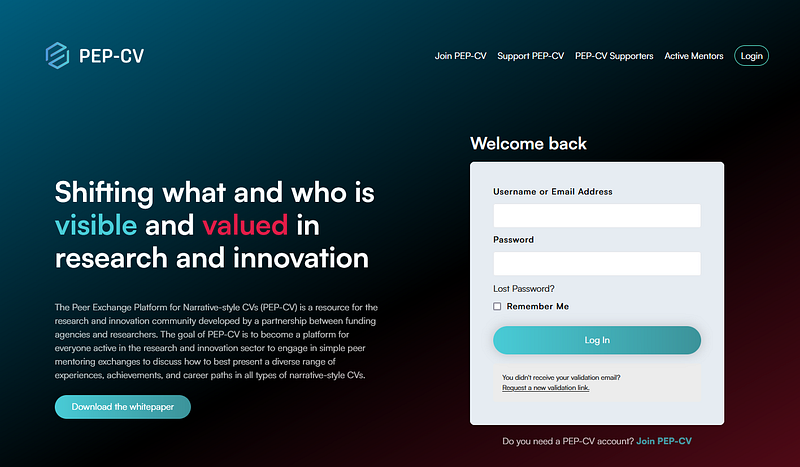
Time to get into the nitty-gritty. Instead of filling your CV with endless pages of all your achievements, carefully consider which ones are the most relevant for the application. The narrative CV allows you to tell a story. Select the most relevant publications and explain your contribution and the processes involved. The narrative CV also has space to highlight contributions outside of your primary scope of work, such as helping with peer-review, supervision, mentoring, and high-quality research, allowing you to reflect on the skills you have gained through these tasks. Describe your role in generating new ideas, methodologies or knowledge, how you supported others in their development, and your contribution to the wider research community and society at large. Once you have a draft ready, head over to Pep CV, a free platform created by a coalition of funders, the MCAA, and the Young Academy of Europe, to find mentors in your field that are experienced with narrative CVs. There you can get help in refining your narrative CV and make your work shine.
However, the narrative CV is not supposed to be the holy grail, it is a means to an end. The current research culture and research evaluation methodology needs to change to foster a more inclusive, diverse, and trusting environment. The way researchers are assessed at the moment needs to be reevaluated, and perhaps a narrative CV can serve as a stepping stone towards the right path. 600+ funding agencies are already accepting narrative CVs in their assessment. Who knows, maybe your narrative CV will be next.
For more information on narrative CVs, head over to https://pep-cv.mariecuriealumni.eu/.