From Observing to Belonging: My First MCAA Conference Experience
by Srishti Goyal
During the MCAA Annual Conference 2025, the Communication Working Group organised a blogging contest, inviting onsite and online participants to share key takeaways, insights, and reflections through engaging blog posts. This contest encouraged participants to engage deeply with various sessions and topics, providing a platform for sharing diverse perspectives and highlighting key moments from the event. After receiving several submissions, the top entries, showcasing exceptional quality and reporting, were published and honoured with awards. The blog post below earned second place in the blogging contest.
--
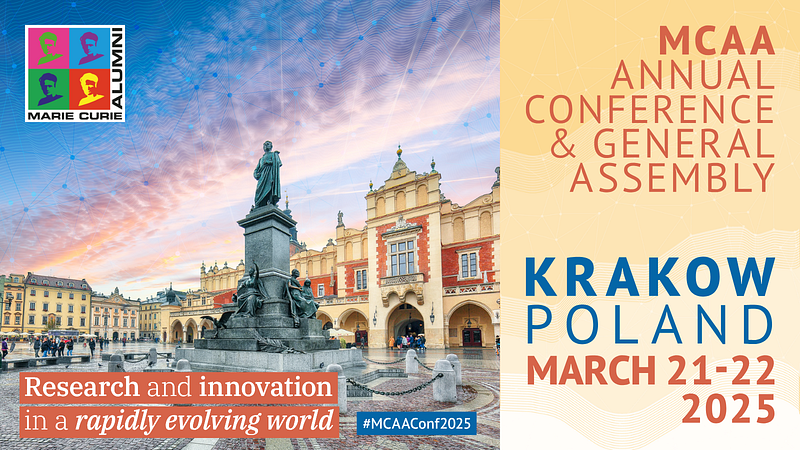
When I became a member of the Marie Curie Alumni Association (MCAA) in October 2021, I did not truly understand the significance of this community. It was only after becoming an active member from July 2024 that I began to grasp the important role the MCAA plays. Attending the MCAA Annual Conference 2025 in Krakow was my first experience with the Association’s flagship event, and it left me feeling genuinely impressed.
The conference helped me see how the MCAA has established itself as a real stakeholder in ensuring that the rights and well-being of researchers across disciplines are both protected and championed. One example of this impact was the launch of the revised Marie Skłodowska-Curie Actions (MSCA) Guidelines on Supervision during the event, a testament to the dedicated work of the MCAA community.
My main agenda at the conference was to cover two sessions as part of the MCAA Editorial Board: the satellite event “Final Conference of the Pandora Box of Whistleblowing in Academia (PAOLA) project,” and the session “AI Ethics & Integrity for Responsible Research & Innovation.” Both these sessions focused on integrity, a topic I have often wondered about in today’s post-truth world, where it sometimes feels like opportunism overrides accountability. I was curious to understand how research can still uphold strong ethical standards.
The answer, surprisingly simple yet powerful, lay in the strength of institutions. Effective institutions, with clear governance and ethical oversight, are crucial for maintaining trust and integrity in research. In hindsight, it is not surprising, especially considering that the 2024 Nobel Prize in Economic Sciences was awarded to Daron Acemoglu, Simon Johnson, and James A. Robinson for studies of how institutions are formed and affect prosperity. Their research shows how societies with inclusive institutions thrive, while those with extractive institutions often stagnate. This alignment between global academic recognition and what we discussed at these two sessions was a striking realisation for me.
Still, institutions alone cannot carry the full burden of public trust. This became clear when I attended another session titled “From Truth to Trust: Science Communication in the Modern Era,” which explored how trust in science is increasingly shaped beyond institutional boundaries. It served as a reminder that while good governance lays the foundation, the way researchers and institutions engage with society ultimately determines whether that trust endures.
Another highlight for me was the lightning talks. I enjoyed how complex technical work was presented in a way that researchers across different fields could easily understand. During the General Assembly, when the winners were announced, I remember exclaiming, “Wow! All of them are women!”
Pradeep, sitting next to me, pointed out that winners are chosen based on research and not gender, and I couldn’t agree more. What truly moved me was seeing how far we have come. From a time when women had limited presence in science and education, we are now at a stage where they are not only participating but also excelling. And how! I am sure Marie Curie would have been proud.
What made the conference even more memorable were the conversations during dinners across all three days. I particularly remember my chat with Eliška, where she shared stories from her youth. Listening to her adventures made me realise that I would never have dared to do the things she had done at that age. It was not just interesting, but also made me think about how differently people live their journeys.
I think attending the conference in person has its own perks. The learnings aren’t just confined to the sessions as they come from every conversation, every small exchange, and every shared story. Meeting researchers at different stages of their careers gave me insight into how they manage work-life balance, something I feel is often missing in the professional culture back home in India. It was also interesting to hear how families and partners support them along the way and become silent participants in their achievements.
Overall, the MCAA Annual Conference 2025 was not just a professional experience but a deeply personal one. It made me proud to be part of a community that is actively working to make research better, fairer, and more inclusive.
I hope that my future work commitments allow me to participate in future MCAA conferences. Regardless, I will continue to contribute in whatever way I can, to the best of my abilities.