Post Ph.D. careers
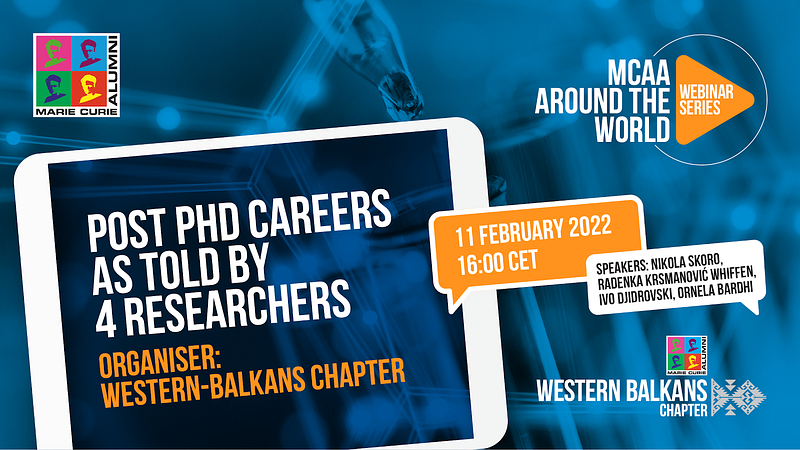
The MCAA has initiated a series of webinars that run each second Friday of the month starting from December 2021. The aim is to provide educational webinars to the MCAA members and non-members as a way to thank for the support received all these years. The webinars are co-organised by the Communication WG in collaboration with a different MCAA Chapter or Working Group each month and cover a variety of topics.
If you missed the second episode, fully organized by the Communication WG, you can find a summary right here!
In this third episode, organized in collaboration with the Western-Balkans chapter, we tackled another very important topic for all the early stage researchers out there: Post Ph.D. careers.
In this episode, we learnt about different career paths including having a glimpse into daily tasks to serve as an inspiration and support the next step that a PhD student has to decide about.
To do that, we invited Nikola Skoro (Senior Research Associate at the Institute of Physics Belgrade), Radenka Krismanović Whiffen (Head of the Project Proposal Writing Unit at STRENTEX ERA Chair and the Founding Chair and Advisor to the MCAA Western Balkans chapter), Ivo Djidrovsk (Scientist, inventor and founder of the in3 Solutions start-up), and Ornela Bardhi (Scientific advisor to the Minister at the Ministry of Health and Social Protection of Albania and Chair of the Western Balkans chapter).
In the next part of the Blog, we report the highlights of the 3rd Episode of the MCAA Around the World Webinar Series, which can also be watched on YouTube.
It is difficult to list all jobs for Ph.D. graduates, mainly because career pathways vary and more often than not depend on the field of study and the country you want to work. Many who earn a Ph.D. thrive outside academia. This post is to introduce some career paths one could take in and outside academia after their Ph.D.
Many might see a career in academia as only teaching, researching, or supervising younger researchers. However, you could find other jobs that might be of more interest for you, not related to teaching or supervising, within academia, such as project management, project proposal writing, or international relations. As an MCAA fellow, but as a Ph.D. student in general, you are often collaborating with project partners from different countries. As such, you learn how to work well in international settings by managing not only the project but also the people. Writing is also an integral part of a Ph.D. You might not be writing proposals for big projects, but you can apply the know-how you have gained in big projects if that will be necessary.

However, not all Ph.D. students remain in academia. And why should they! Industry career is also very much viable because the skills gained throughout the Ph.D. degree are very much transferable there too.
Here are some examples of transferable skills you could apply to other career paths.
All PhDs have had to present their research at conferences or other events. If you like preparing and giving presentations, doing science communication outreach, or anything related to communication then one could look for such positions. Nowadays there are even more such opportunities with jobs in the publishing industry, podcasting, digital marketing, or civil service.
More and more companies are hiring Ph.D. students and that is because they have the subject knowledge, project management, problem-solving, data proficiency, and collaborative skills that are very much in demand. Such companies are in various industries such as pharmaceuticals/ genomics (data science, clinical research, or consultancy), finance (accountancy, data science, or consultancy), technology (software engineering, data science, machine learning, or deep learning), environment (construction, environmental protection, or data science), intellectual property, regulatory matters, etc. A Ph.D. degree is a versatile enough qualification that one can often look outside their area of expertise to find a job.

Besides joining already established companies, you could turn your Ph.D. research, or any other idea you might have, into your own business and be your own boss. Although spinoffs are more common in STEM-related Ph.D. students, social science Ph.D. spinoffs are also possible (publishing your Ph.D. dissertation, becoming a coach, etc.).
Another interesting career path would be working for and with the government through not-for-profit organizations or by working directly within a specific government office. Now more than ever, we need experts in making decisions that impact our everyday lives (the COVID-19 pandemic, climate change, etc.). Such jobs include science advisors, science diplomats, or similar, who work closely with the government and the research community to make evidence-informed policies.

Whatever career path you choose after your Ph.D., it is important to know yourself and what you like, and what you are good at. You can do that by being your own career coach. The key component is asking yourself the right questions. Instead of asking yes-or-no questions, ask who, what, why, where, when, or how questions. The latter will give more insight to work with (i.e., instead of “Do I enjoy my job?”, use “What do I enjoy about my job?”). Also, focus on what “I” can do, and avoid asking multiple questions at the same time.
After understanding your values and mapping your skills, you could learn new skills by taking up online courses. The MCAA also provides many licenses to online learning platforms (such as Coursera). If you want to put some skills to practice, then you could also join a chapter or a working group in the MCAA, or other association/organization.
Being part of international networks, such as the MCAA, will expose you to various people with various career paths that might inspire and help you to pursue yours.
Precious link:
You can watch the full Episode on YouTube: https://youtu.be/WhJa8_gIEeU
Author
Ornela Bardhi, Scientific advisor to the Minister at the Ministry of Health and Social Protection of Albania and Chair of the Western Balkans chapter