Preparing the Next Generation of Scientists: Sharing the Experience of S3 Summer School of Science
Teaching science in school nowadays still looks rather boring and lacks practical experience and creative thinking. To motivate high school students to step into a scientific career, it is important for scientists to know how to address this very specific target audience.
The MCAA Communication Working Group invited the Summer School of Science to address these topics, presenting practical examples and practices. Together with Nikolina Šoštarić, a bioinformatician at Sanquin (Amsterdam, The Netherlands), Alexandre Kempf, a lead research data scientist at Lixo (Paris, France), Dunja Vučenović, a bioinformatician at Illumina (Cambridge, UK), Snježana Kodba, a graduate student at Utrecht University (The Netherlands), and Mario Zelić, a fifth-year student at the Faculty of Medicine, University of Zagreb (Croatia), we learned how to show high school students that science is cool.
On a personal note, there is something unique about this Summer School, and I cannot put it better in words than sharing Dunja’s story that proves the impact and the strong community it was built for over two decades: “The first time I took part in S3 was in 2006. That experience made me fall in love with science, and, as a consequence, I am still doing science! It taught me about the importance of science communication as well as being all right with not knowing all the answers. Also, participating in S3 as a student helped me identify my interests. Since then, I was 3 times a student at the school, 2X project leader, 1X workshop leader/technical assistant and 1X organiser.”
A full recording is available on the MCAA YouTube channel.
Briefly about the Summer School of Science in Požega
The Summer School of Science has been organised for 20 years and is run by a non-governmental organisation Society for Out-of-Frame Education. It relies heavily on volunteers that are passionate about science education. The official language is English.
The School itself is split into two camps, one for the students from grades 9–10, and the other one for the grades 11–12. High school students have to undergo a selection process where their level of English and their interest in the scientific projects are evaluated.
Each camp takes 10 days and covers six projects from different disciplines, e.g., molecular biology, chemistry, computer science, engineering, neuroscience, and physics. The projects are led by Ph.D. and postdocs, selected in advance to help them in defining and planning the projects. Each of the leaders is joined by three/four secondary school students. The aim is to keep the size of the group really small to allow for an individual approach to each student and increase their learning rate. Organisers and technical assistants are always there to give help whenever needed.
How a project is structured and runs
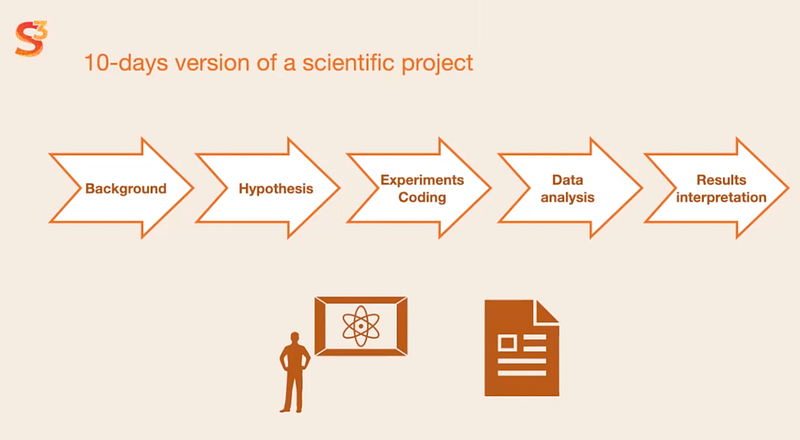
As a project leader, you will start by giving a background of the problem which is going to be studied during the duration of the camp. You will guide the students in defining the hypothesis. Then, all together, you will run the experiments or coding depending on the field of study and the project itself. You will then conduct data analysis and understand the results. In addition, students will have to present their findings, as if they were in a conference, while being challenged by questions from the audience and other project leaders. The final task will be to write a scientific paper based on everything you’ve worked on. The reports are then made publicly available on the website of the School. Each evening ends with guest lectures from well-renowned scientists including Nobel laureates, but also social activities such as pub quizzes and treasure hunts. This offers the possibility for a student to be in the shoes of a scientist.
Most importantly, as a project leader, you are not left alone. Each day ends with a group meeting discussion on any of the challenges encountered during the day and how to help each other towards achieving the objectives while making the school an enjoyable experience for everyone.
Preparing activities for young students
Even though we wish for a smooth way of organising and running a science project like the ones at the S3 Summer School of Science, the reality is quite different especially as we have to take into account several practical aspects.
Here are some of the suggestions that the organisers recommended during the webinar to be considered as early as possible.
- Adjust the level of what you aim for to the level of the students. Don’t underestimate the students, they might learn quicker than you expected. Be prepared to have some additional materials to give the students so they do not feel bored.
- Make sure all the experiments are interconnected and form a story. Everything the students do should lead to that specific goal and to the big question they need to answer.
- Always think of and have backups. For example, when it comes to equipment if you run several steps and one of them during the experiment itself fails then you do not want to depend on that single crucial step on failing or succeeding the project. You might want to consider bringing with you the samples of that specific step to make sure that you manage to go until the very end of the initial plan. It can also happen that you forgot one piece of equipment and you will have to improvise. You will likely be far from your lab and you will be able to count only on a small supermarket near your hotel. Think of different kinds of scenarios to reach the goal.
- The group of students might not be coherent. Use this difference, for example, by pairing the students and making them communicate with each other. Also, let them design the experiments. Don’t plan everything for them and rather listen to their ideas.
- Go outside of the buildings during your research projects, if you can. Students love to go for some fieldwork, e.g., bee catching, collecting microbes in dirt, etc.
- Keep them busy with challenges. Even though they are supposed to rest at night, they love a riddle or a puzzle. Leave them to think about what would be the next step of the experiment, how to test this or that, or think of the conclusions of the experiments.
- You should feel comfortable with the subject itself chosen as a project. Talk to your friends and colleagues about it. Pick a project close but out of your comfort zone and read reviews and papers. Students might be very much into the topic and ask you lots of questions. They are also willing to know your story, e.g., how you became a scientist and what motivates you to practice research and the reasons you love science.
Examples of past projects
Examples of past projects include genomics in medicine (“Can we help House MD?”), molecular gastronomy, chemistry (“What makes autumn colourful? The world of pigments and colours”), computer science (“Who’s winning it? Forecasting sports tournaments”), and neuroscience, to name a few. For a full list of past projects, you can check the Archive.
Three ways you can get involved and support
If the S3 Summer School of Science sounds appealing to you, there are at least three ways you can share support that will be very much appreciated.
- Spread across your networks about it. The application for this year’s edition has started and any high school student willing to participate should apply before the 1st of June 2022.
- Apply and become a project leader to run your project. The selection process usually starts in autumn and there are spots available for the next year’s edition. For that feel free to contact the organisers.
- Consider donating, for example, equipment or contributing financially. The organisers depend a lot on sponsors and donations. Also, the organisers try to keep the participation fee for a high school student at a minimum being set based on the country of origin of the applicant. “Our goal is to reach kids that really like science to be able to join and not for the finance to be something that would prevent them from applying,” said Nikolina. The participation fee of the high school students covers accommodation and medical insurance, while project leaders should take care of their flight tickets solely in most of the cases.
Author
Nicoleta Spînu, Vice-chair of the MCAA Communication Working Group


