Public speaking for Scientists
The MCAA has initiated a series of webinars that run each second Friday of the month starting from December 2021. The aim is to provide educational webinars to the MCAA members and non-members as a way to thank for the support received all these years. The webinars are co-organised by the Communication WG in collaboration with a different MCAA Chapter or Working Group each month and cover a variety of topics.
If you missed the first episode, co-organised by the Brazil Chapter, you can find a summary right here!
In this second episode, fully organised by the Communication WG, we tackled another very important topic for all the scientists out there: public speaking.
In this episode we learnt what communication is, how it works, which are the key elements when presenting scientific results, and many other concepts.
To do that, we invited two experts in science communication, James Bowers (Chief Editor at Polytechnique Insights) and Alexia Youknovsky (CEO of Agent Majeuer) — who are already well known in our community, as we had the pleasure to organise another webinar with them (find out more here).
In the next part of the Blog, we report the highlights of the 2nd Episode of the MCAA Around the World Webinar Series, focussed on public speaking.
What is a communication model?
Communication is the tool which permits to transfer information from one side (sender) to the other (receiver). The objective of communication is to make an audience aware of the concept you are trying to communicate, and why not, make them interested in your research.
When looking at this model, the message is the most important point: think of what your audience has to remember when the communication is over. In order to achieve this, we need to pay attention to some filters: for example, as a sender, you must be aware of the prior level of knowledge of the audience, the language you use and the cultural reference you might make during the talk. But also the audience will have some filters: are they interested in what I am saying? Am I talking clearly enough? Make sure to be on the same level.
To summarise, the key levels of a communication model are 3:
- There is the sender: a speaker;
- There is an audience;
- There is a message to deliver.
How do I make sure the audience is listening to me?
Once you define your message, and you know to whom you are talking to, you want to make sure that the audience will listen to you, but, how can you do that? You certainly can’t read their mind. Well, Alexia explained a couple of nice tricks to do that: “first of all, before you start your talk, you should take few seconds to look at your audience and see if they are quite and they are listening to you; and then, use a hook when you start your introduction: something that can catch they attention.”
The hook can be a question, an image, or an anecdote, something that is connected to your message. You should find a hook that makes them react and actively listen to your message — they need to actively listen to you.
The struggle of most scientists: PowerPoint presentations
James shared his experience of seeing bad presentations that really came in handy. He showed us how to transform a very bad presentation into a good presentation.
He managed to transform the slide you see below, into something which was really nice to follow and interesting, but how did he do it?
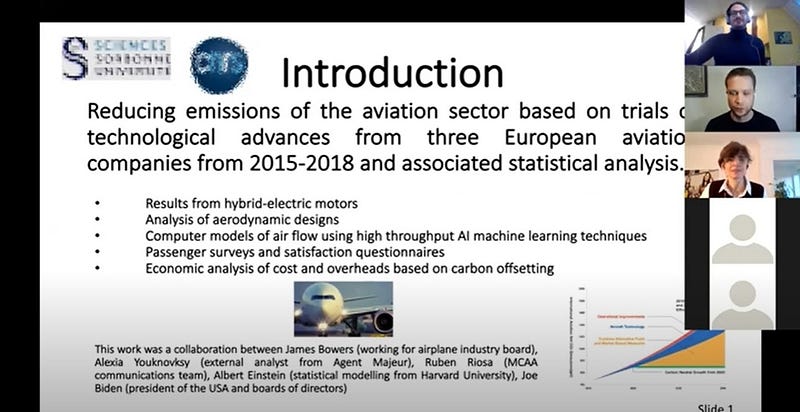
The slide is definitely too busy, we need to reduce the elements that are in it. Some tips below:
- Logos, slides number, dates… We don’t really need them, we can just have a final slide with the logos, we do not have to report them in all the slides, they just take too much space;
- We do not need to write everything down. You just need key words, you want the audience to listen to you, not to read a slide;
- You don’t need to report all the affiliations of the authors of a specific work, just the names are enough;
- The tiny graph on the bottom-right corner of the slide is important, we need to highlight it by adding it to another slide, where it can be fully discussed.
To conclude, the busy slide we are seeing above, could become a sequence of 3 slides, which would help us to have a better control on the audience, as we would be able to talk about one specific topic at the time, and it would look like:
Slide 1. Image of the plane: over this slide to present the topic of the presentation;
Slide 2. Display the bullet points one at a time so as to focus the audience on one single point — Again, Don’t make them read out the slide by themselves, rather drive them through the presentation;
Slide 3. Present the tiny graph in full size on a separate slide where it can have all the attention it needs.
How do I engage a non-scientific audience? The concept of “popularization”
As an expert, you know the science or the technology you are talking about better than the audience you are talking to. This is definitely a great feeling, you feel important, but at the same time, you know that you won’t be able to share your knowledge unless you adapt to the knowledge level of your audience. However, simplifying complex ideas is not an easy task, on the contrary. This is why you should consider the concept of popularization, which is about making your subject more understandable to different audiences. How do you do that?
- Put yourself in their shoes: imagine what the audience needs to know, what is the fun part of your research? What does your topic mean to them in real life?
- Find your originality: what do you know that your audience does not know? Try to catch their attention with something they have no idea about.
- Remove all the excess information: be aware that there is always something to cut and reduce the information you are trying to deliver, so that it will be easier for the audience to understand.
Public speaking and anxiety

You have now arrived at a point in which you know what you want to say (you have a message), you know your audience, you have a great PowerPoint presentation, and you are sure everyone will understand you because you simplified your message enough. However, the last step requires you to have a public presentation, and your anxiety is kicking in. What should you do?
Thankfully, Alexia shared some good tips when it comes to non-verbal communication (e.g. posture, eye-contact, etc.):
- Make eye-contact with the audience;
- Pay attention to your voice (e.g. your tone, speed of your speech, etc.);
- Your overall presence, try to be confident. To do that, you have to rehearse. Practice makes perfection;
- Believe in what you say. You need to present something you really care about.
These points are definitely important, but right now you might think: “What if I have to present virtually?” Don’t worry, we got it covered for you:
- Check that your connection is working properly;
- Make sure your light is on your face and not on your back. The audience needs to see you properly;
- Do not only show your face, but it is nice to show a bit more of your figure;
- Make sure your camera is point right in front of your face, this will improve the eye-contact with your audience even if you are preparing online;
- Check that everyone can hear you properly.
Furthermore, James underlined some further tricks to overcome anxiety:
- Go check out the room where you will present. Stand where you will talk and make yourself familiar with that space;
- Double-check that all your materials work, you don’t want to be on stage and suddenly your materials don’t work;
- Focus on your breath, and try to make yourself comfortable before your talk;
- Once you are on stage ready to present your work, just look at the audience for a bit and make eye contact, there will surely be someone from the audience looking at you, or even smiling at you that will make you feel more comfortable;
- Pay attention to the very beginning of your talk: make sure you are not talking too fast and that you are not moving around the stage too fast. Once you set your pace, you won’t have any problem in keeping it for the rest of your talk.
Conclusions
At the end of this very interesting interview, there was space for an open discussion with all the participants, which covered many other topics that you can listen to in the recording available on YouTube.
To conclude, I want to thank Alexia and James for sharing their knowledge on Science Communication.
Precious links:
Did you miss the live webinar? No problem, you can watch it now on YouTube!
Authors
Ruben Riosa, Chair of the MCAA Communication Working Group
Nicoleta Spînu, Vice-chair of the MCAA Communication Working Group