“Say Yes,” a workshop that teaches how to embrace mistakes as part of the learning process
by Corinne Portioli, Giulia Bruno, and Silvana Munzi
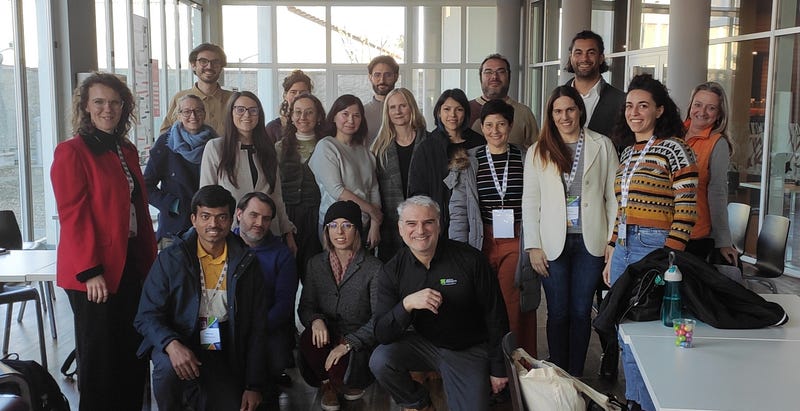
On March 14th 2024, entering one of the rooms in Milan reserved for the satellite events on the eve of the Marie Curie Alumni Association (MCAA) Annual Conference and General Assembly (AC&GA) 2024, a silent observer would have witnessed an unusual scene: a group of people standing in a circle, passing a ball from one to the other while speaking a non-sensical phrase and showing mercurial emotions ranging from anger to sadness, from happiness to surprise.
No, this wasn’t a performance…it was a workshop!
Led by actor, director, and improvisation expert Renato Preziuso and co-organized by Corinne Portioli and Giulia Bruno, “Say Yes: Improvisation Theatre Techniques” was an inspiring improvisation workshop which took center stage on the day dedicated to satellite events of the conference. The workshop offered a dynamic session that ignited creative mechanisms through theatrical improvisation methods.

From stagecraft to research impact
During the workshop, the participants learned techniques such as:
- Free association — Popularized by Sigmund Freud, it encourages individuals to speak freely without censoring their thoughts, regardless of how illogical or irrelevant they may seem. It helps researchers’ creativity and idea generation while improving their writing skills.
- Character transformation — It requires a person to deliberately shift character from one to another rapidly and distinctly, usually by altering voice, posture, expression, or movement. It helps researchers adjust tone, language, and body language depending on the audience and connect empathetically.
- Emotional switch — In this, the performer is required to rapidly change emotional states. It helps in public speaking and engagement.
These techniques are generally used to strengthen narrative skills, train to truly hear and respond to others, improve non-verbal communication and learn to express ideas clearly, even under pressure.
As one participant, Manuela Giovanetti, observed:
Friends, Romans, countrymen, lend me your ears!
This memorable three-hour workshop fostered a collective or perhaps “collactive” creation, with participants sequentially adding elements to a scene or collaboratively representing specific scenarios (e.g., “nightmare,” “Black Friday”), that further led to meaningful interactions.
It taught us that you must pay great attention to others—observe what they do and listen carefully to what they say. We know that it’s easier said than done, as participants realized unsuccessfully attempting a “listening exercise” not once, not twice, but thrice! However, a lesson can be learned from these failures, seeing how a mistake can lead to a plot twist or unexpected outcomes. It gives a new perspective to errors, showing that they can be embraced as opportunities for growth.
To be or not to be… spontaneous
While every great communicator emphasizes body language and non-verbal communication, there is rarely a real opportunity to train these skills in typical communication courses. This workshop made that possible, with exercises focused on posture and movement to express concepts or feelings, like repeating the same gesture and using words to express different states of mind.
Unlike conventional communication training, improvisation training is designed to boost participants’ creativity and spontaneity, improve their belief in their gut feeling, and make them adaptable. In one of the exercises, participants made short presentations, adapting them to the audience’s requests: “add more pathos,” “add more movement,” or “change the emotions,” etc.
Spontaneity, however, is not for everyone. For many people, performing activities that bring them out of their comfort zone can be hard. Sometimes it takes time or a gentle nudge. For instance, during this workshop, what began as a natural hesitation, being in a room full of strangers, charting unfamiliar territory, gradually transformed into a sense of comfort and camaraderie among the participants.
One of the attendees, Silvana Munzi, says:
And then we went out to see the stars again
Did the participants overcome all their communication flaws? Of course not. But did they gain insights into how to improve? Absolutely yes. And did they have fun? Without a doubt. One of the most powerful lessons was that mistakes are part of the process. Participants learned that a “wrong” move could spark new ideas or unexpected directions in a scene, mirroring the unpredictable nature of scientific discovery itself.
A workshop to remember, and repeat
Overall, the workshop was overwhelmingly positive! Attendees found it both enjoyable and informative, with many expressing a desire for this innovative approach to communication to become a staple in future workshops. They recognized its potential to enhance clarity and engagement in message delivery. Participants not only gained useful skills but also made meaningful connections. The informal, low-pressure setting encouraged networking, opening the door to deeper collaborations.
If you missed the workshop, do not worry—there will be another edition soon.
About the workshop instructor:
Renato Preziuso is a versatile professional with extensive experience in acting, improvisation, training, and directing. He has a background in theatrical improvisation and has performed internationally and created numerous improvisation formats across Italy and Europe. As the founder and educational director of “Voci e Progetti” and the Perugia School of Improvisation, he specializes in staging edutainment shows and delivering corporate theater training for various organizations, including Sistema Museo, TIM, and Unicredit. His positive attitude created a welcoming environment that encouraged participation and self-expression throughout the workshop.