The Societal Impact of Researchers
Report and Considerations from the Parallel session of the MSCA2018 held in Vienna in October 2018
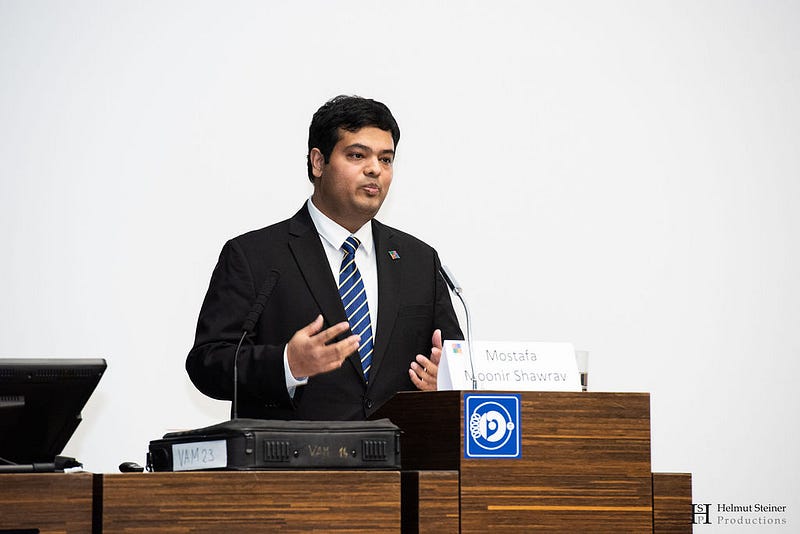
It gives me great pleasure to present the report from the Parallel session titled, “MSCA, Enhancing the Societal Impact of Researchers” at the MSCA2018, held in Vienna, Austria on 1 October 2018.
The workshop was opened and chaired by Zorana Barišić from Croatia’s Ministry of Science and Education. In her remarks, she underscored the objective of the session which is to focus on the stellar researchers funded by MSCA and show how they can better interact with citizens and society.
The first speaker to address the session was Barbara Abraham, Head of Academic Affairs, Institute of Science and Technology (IST), in Austria. IST is a young research institution that kicked off in 2009. It has six different research areas with 49 professors and 34 ERC Grantees. The institute gives high priority to ongoing, world-class research, training next generation scientists and being a role model for science management and science education.
But it takes time to see the commercial application of great scientific discoveries. The commercial application of DNA, for example, was introduced nearly 50 years after its discovery.
Barbara Abraham also presented various science communication activities which IST organises (Open Campus Day) or takes part in (Open Science Festival). She also stressed the need for transparency, or else, obstructing political or corporate entities from influencing the course and outcome of research. This does not necessarily mean that a political organisation or a certain corporate sector will not interact with a research institution.
During the discussion, Bodo Richter, Deputy Head of the Marie Skłodowska-Curie Actions (MSCA) unit at the European Commission, highlighted the core objective of MSCA: curiosity driven research for all fields including Social Science and Humanities (SSH). He also sided by the position that the impact of research is only visible upon society and social changes after significant time. He said one of the key aims of MSCA was to think objectively about what science is, and the role that scientists play within society. Participants of the session suggested that the core budget of MSCA remain bottom-up and focused on curiosity-driven research.
There is no doubt that a researcher’s main task is research. But sometimes setting science communication or other outreach activities over research may become a problem for the researcher.
In this case, institutions providing EU funding should be able to help researchers, assisting in public outreach events that help raise awareness about science. Such institutions need to be more actively engaged in creating and offering training as well as positions geared towards Open Science, Science Communication and Science Policy. Organisations like Marie Curie Alumni Association (MCAA), for example, are providing essential training on science communication and other related skills for current and past fellows. They are offering MCAA members research integrity courses through resources such as Epigenium.
Eva Wysocki, Programme Manager at the Austrian Science Fund (FWF), was the second speaker of the session. FWF is Austria’s central funding organisation for basic research, which is also open for application-oriented projects. It is an independent and inquisitive funding programme that carries opportunities for scientists in all fields of research and at various career stages.
All FWF funding programmes run under three major categories. The first includes “Exploring New Frontiers — Funding of top-quality Research.” The second focuses on “Cultivating Talents — Development of Human Resources.” The final group concerns “Realising Ideas — Interactive Effects Science — Society.” FWF actively supports Open Science, Open Access, and was one of the first signatories of the Berlin Declaration, in 2013. About 83% of all peer-reviewed publications of FWF-funded research can be accessed in Open Access journals.
Collaboration between European and national funding schemes were also discussed during the session. The Erwin Schrödinger (ES) Programme from FWF provided, for example, a great sample of synergies between European and National Funding schemes. The programme is similar to the MSCA-IF and when it started in 1985, there was no return phase. The impact of the programme has been evaluated twice, in 2006 and 2014, respectively. Bibliographic analysis and online surveys were used in the most recent review. Still, an interesting find of the first survey showed that more than 50 % of former fellows held a university chair or position 15 years after completing the fellowship. Average academic output ranked at around 4.2 publications.
Since 2009, the ES programme has come to incorporate four successful COFUND grants. A return phase and remuneration of pension funds are now part of the grant. In all, 369 grants have been approved out of 786 applications. A total of 343 Schrödinger fellows chose 360 host-institutions in 24 different countries for the outgoing phases (16 fellows with more than 1 host). According to the evaluation, among researchers abroad, Schrödinger fellows had stronger positive impact on their research output than researchers without the fellowship.
The third speaker was Delyth Morgan, head of research programme development for the Office of the Chief Scientific Adviser for Wales. She showed how European Structural and Investments Funds and Horizon 2020 funding are helping build research capacity in Wales. According to a Stimulus Paper presented, there was a big gap in STEM. More than 600 positions in STEM were needed to achieve 5 % Research Council Funding. To fill this gap, the government initiated various funding programs to attract researchers from different career levels. Programmes such as Rising Stars, Recapturing Talents, and MSCA COFUND Fellowships, have been key in this effort. As a result, more than 130 gaps have been filled with new researchers.
The last speaker of the session was Inka Vaverková from the Ministry of Education, Youth and Sports of the Czech Republic. She presented a string of related initiatives from the Czech government, while underscoring existing synergies between Horizon 2020 and structural funding. Most recently, the Czech ministry of education has launched a call for proposals for Marie Sklodowska-Curie Actions — Individual Fellowships Seal of Excellence holders. The move is in line with attempts to support the international mobility of researchers. In addition, Inka Vaverková stressed the flexible mobility scheme for selected programs.
Overall, the session was successful and thought-provoking. From a personal standpoint, I can only affirm that I have learned a lot from these discussions. The most important points made are that:
- Science should have a greater positive impact on society.
- Stronger synergies are required between National and European funding mechanisms, making the mobility schemes so much more attractive and helping to stabilise the careers of mainly young researchers.
- National funding initiatives should be used to support and boost the scientific capacity of countries by focusing on quality research.
2019 MCAA GA & Annual Conference 👉 https://bit.ly/2R7lsly
About the author
Mostafa Moonir Shawrav is the vice-chair of the Marie Curie Alumni Association (MCAA) and a nanotechnology researcher at TU Wien. His training and expertise include Science Diplomacy, Intercultural competences and Entrepreneurship. He also provides training on Career Paths for Researchers at universities and research institutions.
Twitter: https://twitter.com/mmshawrav
LinkedIn: https://www.linkedin.com/in/shawrav
Follow us on Medium
Have any comments on this story? Make sure you share them, using the comment form below.


