Support Ukraine Now: Urgent Needs and Proactive Responses
The Marie Curie Alumni Association shared support for the Ukrainian scientists and scholars from the first day of the war. Among several initiatives, the most recent one was the organisation of a session at the Annual Conference in Lisbon on the 27th of March.
The session “Support Ukraine Now: Urgent Needs and Proactive Responses” was chaired by Valentyna Romanova (Member of the Japanese Association of Ukrainian Studies and Japanese Association of Russian and East European Studies) and co-organised by Oleksandra Ivashchenko (the Leiden University Medical Center / The Netherlands Cancer Institute — imaging physics resident in Radiology and Nuclear Medicine, Ukrainian outreach Coordinator of the ScienceForUkraine; Editorial board member of the MCAA) and Pavlo Bazilinskyy (Eindhoven University of Technology / Assistant professor; team leader of the Project that arranges direct help for volunteers in Chernihiv).
The session aimed to address three objectives:
- Reinforce the MCAA’s public statements and highlight the MCAA’s contributions
- Articulate scholars’ needs due to Russia’s full-scale invasion
- Call for individual and joint actions to help scholars affected by Russia’s war against Ukraine including the opening of more remote positions and scientific collaborations
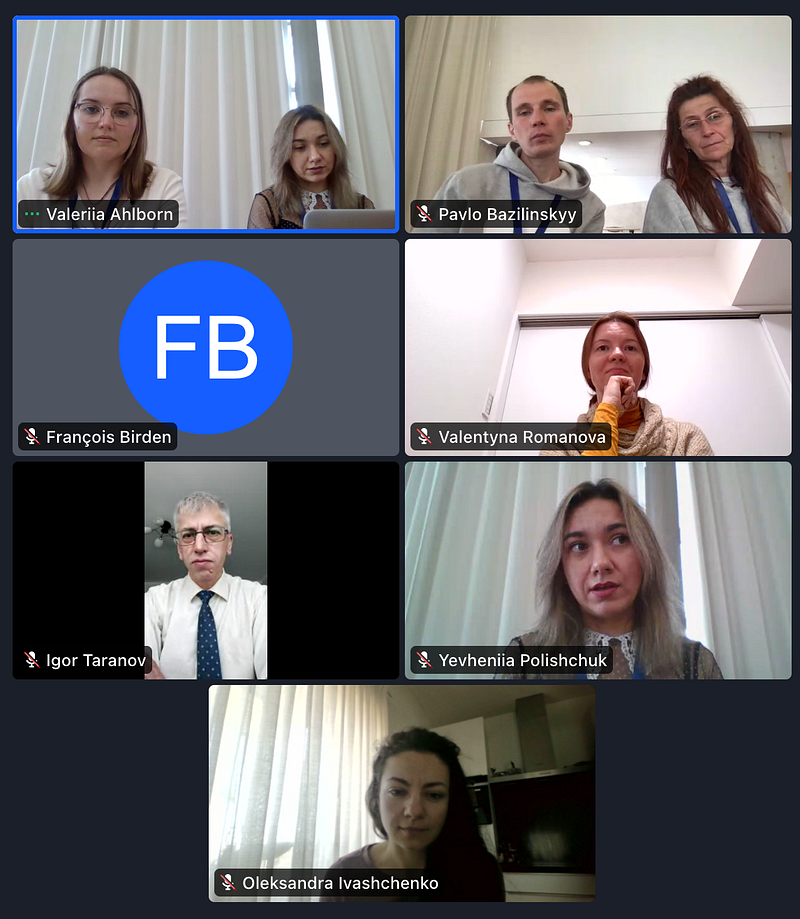
Key messages discussed and presented by the invited speakers
Igor Taranov, Director General of the Directorate of Science and Innovation of the Ministry of Education and Science of Ukraine:
- More than 500 educational institutions are damaged or destroyed
- Pryazovskyi State Technical University, Sumy State University, V.N. Karazin Kharkiv National University, nuclear subcritical facility “Neutron Source Based on Subcritical Assembly Driven by Linear Electron Accelerator”, which is based at the National Scientific Center “Kharkiv Institute of Physics and Technology” have been damaged
- The occupiers also launched a missile strike on “ANTONOV COMPANY”, an aircraft factory in Kyiv and destroyed industrial enterprises in Shostka, Sumy Region
- There are 21 collective use centres with unique scientific equipment, but six of them are located in active hostilities areas
- The future of these centres is unknown, e.g., how many will exist after the war
- Several science and innovation challenges are already identified including: (I) Loss of life among employees of higher education, scientific institutions and innovative enterprises, (II) National grant programs of the National Research Foundation of Ukraine being halted due to budget sequestration, (III) Inability to conduct scientific and scientific-technical expertise, (IV) No conditions for preparing applications for international science and innovation support programmes
- Over 78k scientists and innovators represent the target group and that requires support such as: (I) Special academic mobility programmes for internally displaced researchers from Ukraine, (II) Grant support for virtual mobility, (III) Establishing special offices to support Ukrainian researchers and assist in preparing applications for international programmes to support science and innovation
Prof Olena Bazilinska, National University of “Kyiv-Mohyla Academy”
- Shared her story as a researcher in Kyiv and presented her experience and family history
- Staff, students, professors across the country need support
- A big majority of the academic staff are 50+ years old and do not know English for professional use
- Students are looking for ways to continue their education
- She works at the Ukrainian Free University in Munich, Germany, as a guest professor while also helping researchers and staff who left the country temporarily
- She encouraged the creation of similar facilities
Yevheniia Polishchuk, Vice-head of the Young Scientists Council at the Ministry of Education and Science in Ukraine
- The Young Scientists Council at the Ministry of Education and Science in Ukraine is an advisory body established to promote the realisation of the constitutional rights of young scientists to participate in the formation and implementation of the state policy in the field of scientific, scientific-technical and innovative activities
- The current situation in Ukraine is that 3 million refugees have left the country, more than 6300 academic refugees among those who left, everything in terms of studies is frozen and Ph.D. studies are suspended
- Policies should be targeted per category of type of scholars such as: (I) those who are staying in Ukraine, (II) those who left Ukraine after 24/02/2022, (III) those who had left Ukraine before 24/02/2022, (IV) those who left on occupied territories, (V) Other types
- Near 40 applications went through Young Scientist Council
- Types of existing assistance at the academy society include: support for Ukraine by universities/NAs/labs statements on their official web-pages; shelter and hosting; individual scholarships; psychological support; legal support; humanitarian
Valeriia Ahlborn, Ph.D. Student at the University of Muenster
- “Am I also responsible for the war in Ukraine and that I did not want it?” This was the question Valeriia started her talk with
- For her, the responsibility does not mean sadness and guilt, but also, taking actions
- Her main message was to let science bridge the cultures and ended presentation with the below quote
Ukrainian scientists and scholars are in need of remote positions. We kindly invite the reader to check the press release of the #ScienceForUkraine initiative that can be found here.
Authors
Nicoleta Spînu, Vice-chair of the Communication WG
Oleksandra Ivashchenko, Editorial board member


