Thou shalt not name innovation in vain
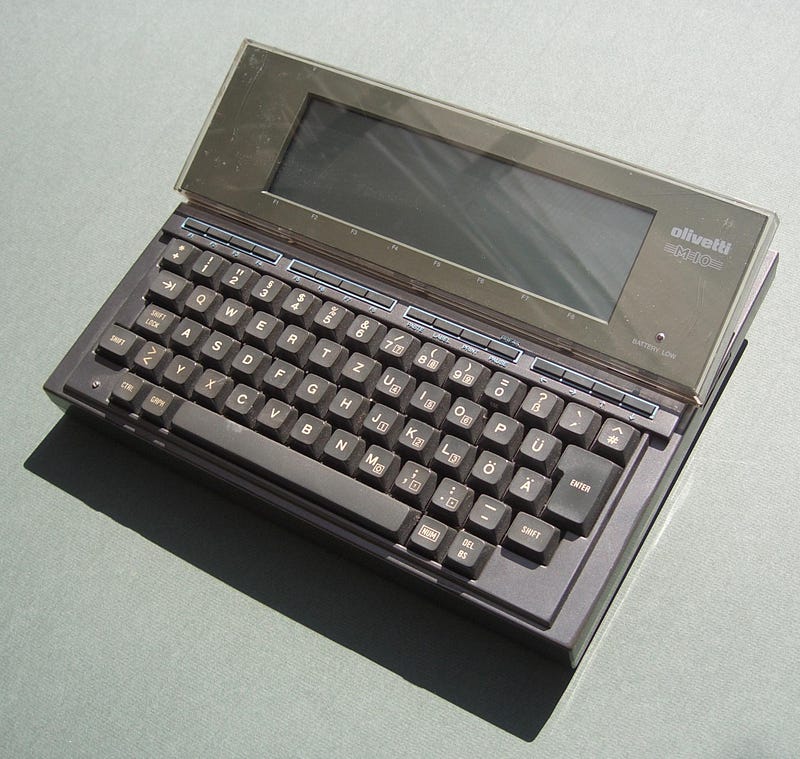
It was 1984 when I first met a personal computer (see figure 1). Like many other children of my generation, I witnessed the surge of personal computers from simple monochromatic, command line, difficult to use machines, to familiar pieces of furniture in every office and house. I witnessed the advent of the digital revolution, which brought us into the information age. Our society has been deeply impacted by the accelerated, amplified, and organized flux of information caused by the advent of personal computers.
Quite an innovation! But only few people would have said that back then. In fact, before personal computers had a noticeable effect on GDP, it took a long time before they were appreciated. It wasn’t until the late 1990s that real economic impact could be observed in the productivity statistics.
Innovation is not a single event
You might think that 10 to 15 years for such an innovation is a reasonable incubation period. Effectively, the history of personal computer is much longer. Experts agree that much of theoretical and technical development was conducted at the beginning of the 20th century by scientists like John von Neumann, Alan Turing, Enrico Fermi, and many others.
A tipping point in its development was the so called ‘mother of all demos’. It took place on December 9th, 1968 at Menlo Park, where an engineer called Douglas Engelbart reported on the project aimed to ‘augment human intellect’. Engelbart unveiled a working prototype of a machine with a screen, mouse, keyboard, and even word processor and video conferencing capabilities, to show how ‘intellectual workers’ could interact with computers.
It took approximately 30 years for this innovation to make an impact on society. Although we now give take for granted the use of computer, the path to this innovation has been long and plenty of contributors.
Know thy customer
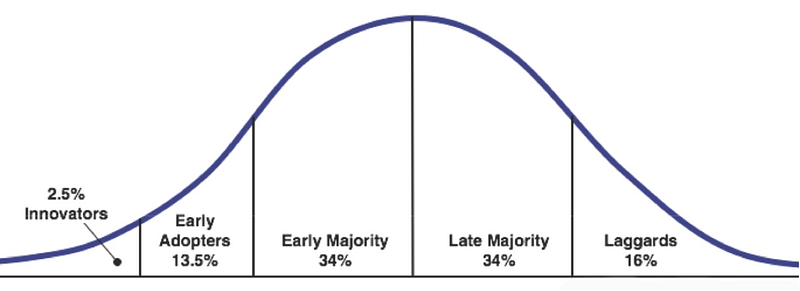
The importance of early customers has been acknowledged only recently. Although their role in the ‘innovation adoption dynamics’ (see figure 2) was recognised in the seminal works of Everett Rogers and Frank Bass in the 1960s, it wasn’t until the early 2000s that it was noticed how important it is for innovators to get feedback from customers and to ‘develop them’.
Nonetheless, the common pitfall of many innovative companies, is that they are mostly focused on product development rather than on the customer’s needs. The history of innovation is full of examples of bad, yet successful products, and of good but unsuccessful ones that few people have had the opportunity to try before they were forgotten.
The popular ‘lean start up’ approach is based on customer discovery and customer development as cornerstones for successful innovative ideas.
Innovation is not always technological
What do Netflix, Airbnb and Facebook have in common? They have been extremely successful by using fairly ordinary technological tools within a new business model. For them, disruptive innovation consisted essentially in applying solutions (web development tools) to solve problems (find a ride, accommodation, friends) in a new way.
Most innovations are disruptive only if conceptual changes to the logic of existing value chains are made.
In my opinion, governmental agencies and policy makers should shape their funding programmes according to this principle. If other elements are not included in the process, investing only in technology might result in a low return in investment.
Innovative Researchers
I hope I have given a broad picture on three important points:
- technological innovation mostly takes decades and is highly risky;
- before the product, innovators should care about customers’ needs;
- disruptive innovation is due to the introduction of new business models.
These concepts beg the question: why is there such a great push for researchers to become innovators and entrepreneurs? How could they be disruptive without knowing how current business models work, or with scarce interaction with customers?
My take is that many researchers develop skills that make them ideal entrepreneurs. They are resilient to failure, used to running experiments (the lean approach is nothing else than that!), are analytical and capable of linking different concepts together to find new solutions.
In a time when we need to boost economies, researchers who recreate themselves as entrepreneurs will be the protagonists of future innovation!
About the author
Marco Masia is a former Professor of Theoretical Chemistry who works as Innovation Consultant for businesses and not-for-profit organisations. He also provides training courses, mentoring and coaching for entrepreneurial researchers. Follow him on Twitter and LinkedIn.
Follow us on Medium
Have any comments on this story? Make sure you share them, using the comment form below.