Why the MCAA's voice in science diplomacy matters more than ever
During the Marie Curie Alumni Association (MCAA) Annual Conference 2026, the MCAA Communication Working Group organised a blogging contest, inviting onsite and online participants to share key takeaways, insights, and reflections through engaging blog posts. This contest encouraged participants to engage deeply with various sessions and topics, providing a platform for sharing diverse perspectives and highlighting key moments from the event. After receiving several submissions, the top entries, showcasing exceptional quality and reporting, were published and honoured with awards. The blog post below earned second place in the blogging contest.
--
My journey with the Marie Curie Alumni Association (MCAA) Policy Working Group began with a chance encounter. At the 2025 Annual Conference and General Assembly, held in Kraków, Poland, I met Theodota Lagouri, the Chair of the Policy Working Group (WG). What struck me immediately was her account of how the MCAA, a non-political body, contributes to society through the intersection of research and policy. The Policy WG's commitment to bridging these two worlds was compelling enough that I joined as a Marie Skłodowska-Curie Postdoc fellow, and I've been a proud member of this remarkable community ever since.
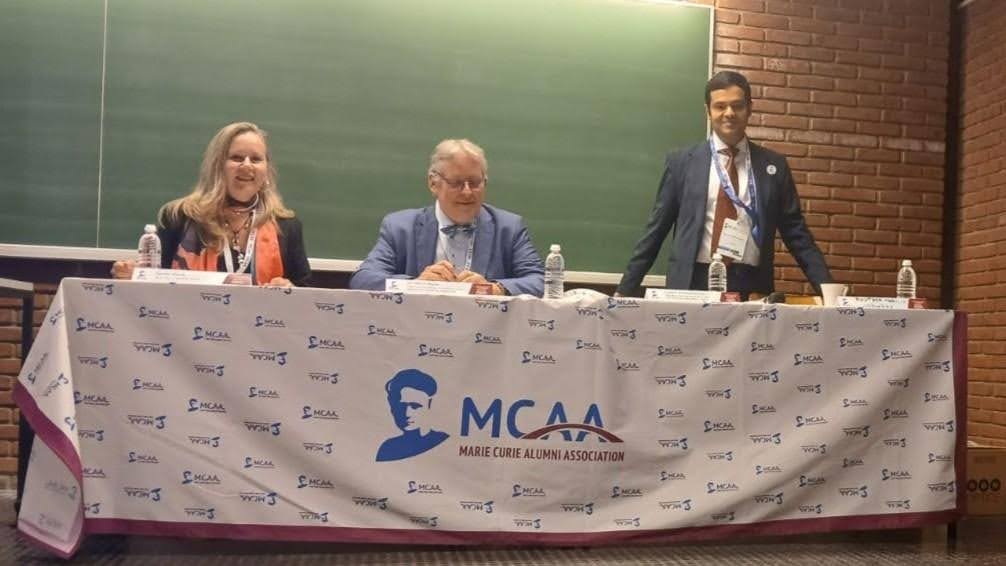
Fast forward to April 2026, and I found myself serving as an onsite rapporteur at the 13th MCAA Annual Conference in Brussels, Belgium. The session I covered, “Empowering researcher networks as strategic actors in science diplomacy”, turned out to be one of the most thought-provoking discussions I've witnessed in this space. Here's what unfolded.
Setting the stage: The conversation we can't avoid
The moderator, Sandra Rebok, MCAA Policy Working Group Science Diplomacy Task Force Leader, opened by referencing the 2nd European Diplomacy Conference and its theme of “Bridging divides in a fragmented world,” zeroing in on the role that non-state actors play in science diplomacy. The framing was deliberate: this was not going to be a comfortable, academic conversation. The stakes were real, and the panellists made sure everyone in the room understood that.
She named what many in the room already felt: whenever geopolitics fractures, researchers are among the first affected. It wasn't a claim that needed defending. It was a reality the audience recognised immediately.
Researchers on the front line: No longer a cosy space
Jan Marco Müller, European Commission, Directorate-General Research and Innovation (DG RTD), one of the speakers, framed the challenge around three critical realities:
- Geopolitical fragility: Geopolitics is reshaping the conditions under which researchers work. Scientific collaboration depends on openness, mobility, and trust, all of which erode rapidly when conflicts escalate.
- Innovation urgency: The urgency of research and innovation itself, think vaccine urgency during a pandemic, cannot wait for political tensions to resolve.
- Sustained diplomacy: Science diplomacy can no longer afford to be reactive or peripheral. It must be deliberate, sustained, and treated as essential infrastructure.
- Values-driven diplomacy: As Jan put it, “Science diplomacy is no longer a cosy space. It has become values-driven, anchored in commitments to Open Science, equitable access, and the protection of research communities, and more inclusive and female-driven.”
A changing landscape: New voices at the diplomacy table
Another speaker, Luisa F. Echeverría-King, member of the Organisation for Women in Science for the Developing World (OWSD), also acknowledged that research networks have become important actors in science diplomacy, not just presenting findings but actively shaping and sustaining scientific collaboration.
Later, other speakers built on this point, noting a broader transformation in who participates in science diplomacy and how it functions. Research networks, not just governments, are emerging as significant actors, helping to create and defend the conditions under which research can continue. This shift toward distributed, networked diplomacy was presented as both a strength and a necessity.
The sanctions dilemma: Sanctions hit and science doesn't dodge
Perhaps the most urgent issue raised was the impact of sanctions on research. Speakers called for an open debate on how restrictive measures carry unintended consequences for scientific cooperation. The argument was stark: sanctions can sever research relationships, limit access to shared infrastructure, and isolate entire research communities. Science diplomacy, the panel argued, has a distinct role in mediating these effects, one that policymakers too often overlook.
The MCAA as a model of trust: Non-political, non-negotiable
Another speaker, Mostafa Moonir Shawrav, from the MCAA, highlighted that: “The MCAA is offering a unique model. As a network that collaborates across organisations and engages researchers in both research and policy, it operates as a trust-based, politically non-affiliated body.”
Mostafa further emphasised that the Association applies consistent standards rather than differential rules, and contributes meaningfully to debates around Open Science and the as open as possible, as closed as necessary framework. Its independence from political parties, he argued, is a genuine source of credibility, something increasingly rare in polarised times.
Open Science needs active defence: Keeping the doors open takes work
The session also addressed the need for distributed and resilient scientific infrastructure: systems that are flexible, reliable, and not dependent on any single political arrangement. Keeping science open, the panel stressed, is not just an ideal. It requires active cooperation to rescue and defend, particularly in the context of ongoing conflicts and accelerating climate challenges. Openness doesn't sustain itself. It demands intentional effort.
Urgency is no longer the question: The question is whether networks like the MCAA will get the resources to match the challenge
The tensions surfaced in this session between openness and security, values and pragmatism, political imperatives and scientific necessity are not problems to be solved in a single sitting. They are structural conditions that demand greater institutional sophistication from the research community.
What emerged clearly, however, was a shared recognition that inaction carries a measurable cost. Every fractured collaboration and every stranded early-career researcher represents a loss not only to individuals but to the collective capacity of science to address challenges no single nation can confront alone. Climate change does not observe geopolitical boundaries. Pandemics do not respect sanctions regimes.
The MCAA occupies a distinctive position in this landscape: Transnational without being governmental, values-driven without being partisan, grounded in the lived experience of researchers rather than in the abstractions of foreign policy. Walking out of that session in Brussels, one thing stayed with me: When the world fractures, it is networks like the MCAA built on trust, not convenience, that hold science together.