From Funding to Careers
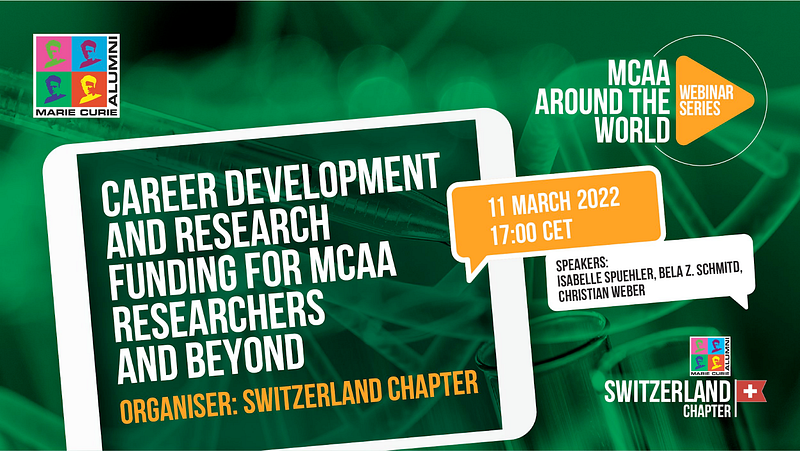
The MCAA has initiated a series of webinars that run each second Friday of the month starting from December 2021. The aim is to provide educational webinars to the MCAA members and non-members as a way to thank them for the support received all these years.
The fourth episode, organised by the Communication Working Group together with Switzerland Chapter, tackled the topic of Career Development and Research Funding for MCAA Researchers and Beyond. The recording is made available and can be watched on the MCAA YouTube channel.
Research funding is at the heart of research careers no matter the discipline, be it social or quantitative sciences. The reasons are various, one of them being the intention to shift the evaluation of a research project to peer review in order to ensure high-quality outcomes. At the same time, research funding is being used as a means to evaluate a scientist’s career.
The MCAA Research Funding Working Group is here to support you.
Christian Weber, the chair of the MCAA Research Funding Working Group, presented the opportunities from funding to careers that this Working Group brings to the MCAA members. Being quite a young community within the MCAA, it focuses on supporting MCAA in a sustainable manner by running various Task Forces. It also aims to connect the MCAA members around a shared topic of interest and challenges in research funding and running. For example, organising grant sessions and research funding-focused events and offering internal guidance to the MCAA researchers. Among other major activities are project management such as supporting the hiring of long-term staff for projects and collecting/condensing information about running projects, supporting MCAA in proposal writing and planning, and interfacing between external requests and the board. The MCAA members are encouraged to get in touch and be active in taking initiatives to further develop the Working Group.
Your team is key to advancing your scientific career. Choose wisely.
No matter the research proposal, you are not alone in running it. It is a team effort either led by you or being part of one. How should you pick the members of your team? Whom to hire especially if you are a science leader?
Béla Z Schmidt, at the Switch laboratory at VIB in Leuven where he has been working as a science writer for almost three years with previous research experience in the USA, Hungary and Belgium, has interviewed more than 100 Principal Investigators about their academic career including securing funding, hiring the right people and setting up a successful research group.
Through his interviews, three key traits in a new person coming to a lab were identified to help a scientist select carefully his team:
- Honesty,
- Communication skills/personal connection, and
- Ability to get along with others.
In his recent book, Career Advice for Young Scientists in Biomedical Research, Schmidt explored ways to help aspiring science leaders in shaping their professional path as well as their personal identity. His book offers insights into all aspects of a scientific career including the emotional side of the daily tasks, e.g., how to deal with rejections. It provides answers to questions about how someone knows if a project is going in the right direction or if a topic is worth being pursued. Also, it summarises recommendations about how to write grant applications and scientific publications, explaining through examples and best practices, a fascinating compilation and resource that no one wants to miss.
We kindly invite you to consider reading the book to inspire and help you advance your scientific career. More details https://bit.ly/3H7KhbQ.
An article by the MCAA Communication Working Group.


