What can you do to support scholars at risk?
Scholars (e.g. doctors, researchers, professors) are often threatened by war conflicts, terrorism and repression, and therefore forced to leave their countries. In 2015, more than 1 million refugees and migrants arrived in Europe via the three Mediterranean routes from North Africa and Turkey, whereas about 141 500 people arrived in 2018 . Nowadays, many international organisations and higher education institutions are making efforts to rescue scholars at risk by providing them safe and secure places to continue their academic careers.
Some examples of funding schemes for the inclusion of refugees were discussed at the conference of the Urban Agenda Partnership on Inclusion of Migrants and Refugees on 4 December 2018 in Brussels. The European Commission funds several programmes that support early-stage students and academics who are refugees or at risk, such as BRiDGE step I and II. Moreover, the Philipp Schwartz Initiative of the Alexander von Humboldt Foundation is supported by the German Federal Foreign Office.
However, funding alone is not enough. It takes several years to adopt an efficient system to ensure that refugee researchers can be competitive in academia and industry, and settling in a new country brings along many challenges: learning a new language, building up a new network, adapting to a new academic culture, and supporting a family in a new country — to name a few.
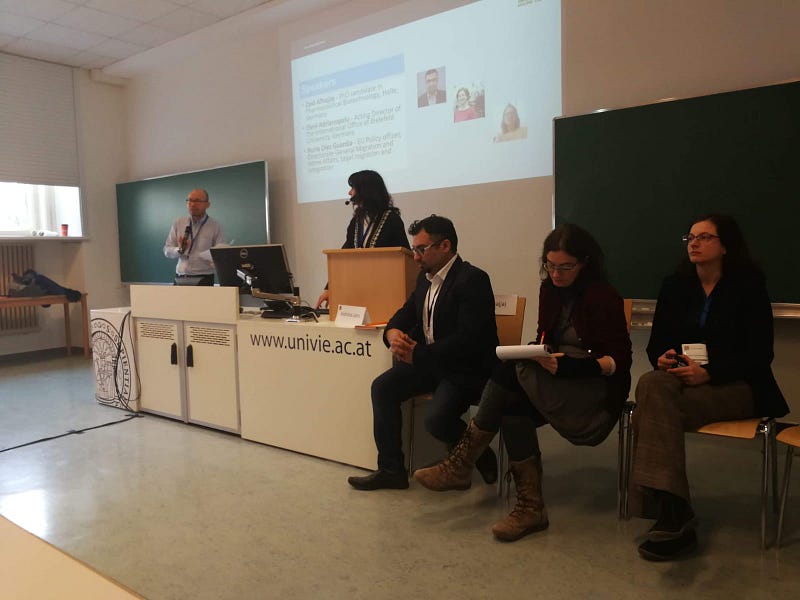
To this end, programmes and initiatives require critical evaluations, and long-term initiatives for career development and financial support are needed to enhance inclusion of refugee scholars. The Marie Curie Alumni Association (MCAA) could play a role in this effort by expanding on some of the resources that already exist, such as webinars, information databases and peer-to-peer mentoring. To that end, the Refugees in Higher Education task force of the MCAA’s Policy Working Group organised a session titled ‘What can you do to support academic refugees to enter academia and the labor market?’ at the MCAA Annual Conference on 25 February 2019.
During the session, the documentary movie Science in Exile , produced by The World Academy of Sciences and directed by Nicole Leghissa, was screened to raise awareness about the challenges faced by academic refugees, when fleeing war and settling in a foreign country to find safe places to continue their careers and lives. The movie tells the story of four academic refugees who were forced to leave their native countries to pursue their academic careers abroad.
Beside their challenges, existing supporting initiatives of international organisations and academic institutions are also showcased. The movie was supported by an expert panel, Zaid Alhajjaj (a scientist featured in the movie), Nuria Diez Guardia (a European policy officer) and Eleni Adrianopulu (the coordinator of the EU-funded BRiDGE projects at Bielefeld University), who were invited to present their perspectives and the supporting initiatives for scholars at risk.
Therefore, their integration process is usually slow and tedious. This urges an acceleration of these processes to give scholars early and equal access to scholarships and job positions in hosting countries. A good example is the Rapid Response Mechanism for Higher Education in Emergencies established by the Global Platform for Syrian Students, whose aim is to remove barriers that refugees face to get access to higher education institutions and provide more, better and faster academic opportunities for refugee students thanks to a combination of online solutions, help desk services and financing facilities.
Additional supporting initiatives are BRiDGE step I and II projects, which are coordinated by Eleni Adrianopulu together with a network between various EURAXESS partners and research centres in eight European countries. Both projects promote the career development of highly skilled refugee scientists by providing them internship programmes, mentorship and peer networks. MCAA members, academics and industry representatives are invited to participate in BRiDGE projects’ activities by supporting refugee scholars with training and mentoring programmes.
Therefore, synergies between different projects should be established to guarantee that such projects can be scaled up and self-sustained after the end of the funding. Long-term integration projects are necessary, because refugee scholars are more vulnerable compared to their non-refugee peers. This is due to the fact that refugee scholars are often not (immediately) admitted to higher education institutions, they may need more time to adapt to new working and living environments, and their CVs are less competitive compared to their peers’ due to the lack of recent scientific publications.
In this regard, associations such as the Global Young Academy and MCAA should promote networking activities between academics with the involvement of scholars at risk. Through opportunities like this, they can exchange and gain knowledge from talented scientists in many disciplines around the world, to develop their careers, and feel more integrated in the host society.
We should acknowledge that the inclusion of refugee scholars in higher education institutions, as well as public and private research institutions, enriches the research landscape by bringing new knowledge and perspectives, which, in turn, will help the development of an inclusive and global society. Diversity in higher educational systems is one of the key factors to fight populism and xenophobic fears and to protect the next generation of young people. Promoting interrelationships between academics, making people aware of the stories of refugees and developing support initiatives for refugees provide a fundamental contribution to an inclusive society.
About the authors
Andreina Laera holds a PhD in Advanced Biological Waste-to-Energy Technologies, a European-funded Joint Doctorate Programme. She is also leader of the task force Refugees in Higher Education of the Policy Working Group of the MCAA. Follow her on LinkedIn.
Dr Gábor Kismihók is head of the Learning and Skills Analytics Research Group at the Leibniz Information Centre for Science and Technology. He is also chairing the Research Funding Working Group and leading the Career Development Policy Task Force of the MCAA.
Dr Brian Cahill is the Programme Manager of the TRAIN@Ed MSCA COFUND Fellowship at the University of Edinburgh. He is a member of the Governing Board of EuroScience.
Dr Pinar Burcu Güner is a postdoctoral researcher at Bielefeld School of Public Health at Bielefeld University in Germany. Dr Güner is a member of the Policy Working Group Task Force for Refugees in Higher Education.
Follow us on Medium
Have any comments on this story? Make sure you share them, using the comment form below.


