Special Issue - Science communication: Making research accessible - There is plenty of room in the panels - December 2025
Julie Nekola Nováková is a science communicator at the Institute of Physics (FZU), Czech Academy of Sciences, and an evolutionary biologist at the Faculty of Science, Charles University. She likes connecting science communication with art, having produced several science outreach anthologies, an exhibition, science communication theatre days, educational comic books, and more.

How do you convey abstract scientific topics, such as the not-quite-intuitive world on the nanoscale, its diminutive dimensions and enormous possibilities, to children? Comic book narratives might be the answer!
Show and tell: Visuals and stories
How many nanometres does your hand measure? How does fullerene, a molecular soccer ball, compare to an actual soccer ball in size? And why does nothing in the nano-world stay still?
Answers to these questions are difficult to explain merely in words; the scales and behaviour of particles are just too far away from the world we normally think of. That’s where visuals come in. However, to create interest in the visuals and drive curiosity, something more is needed: a story.
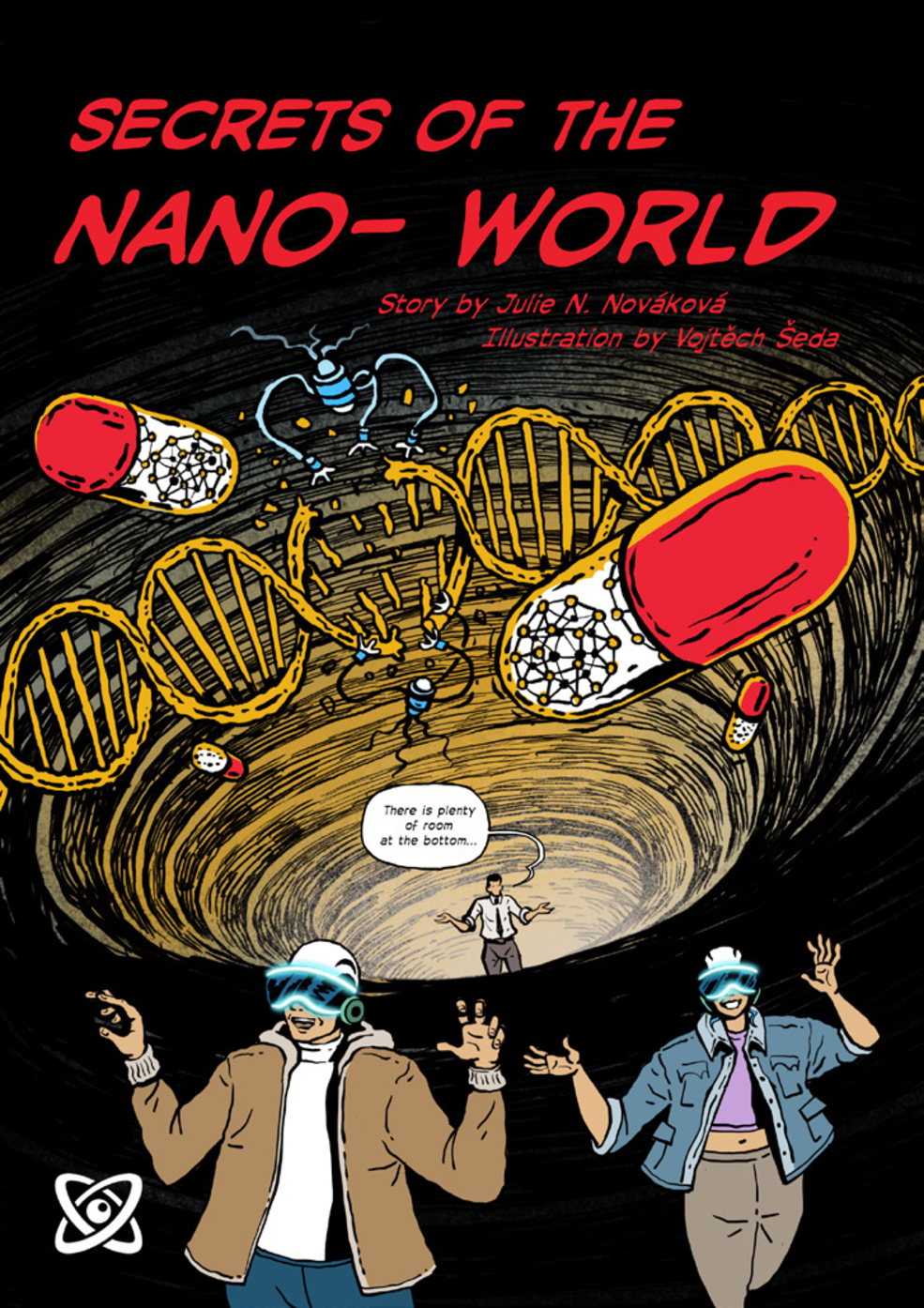
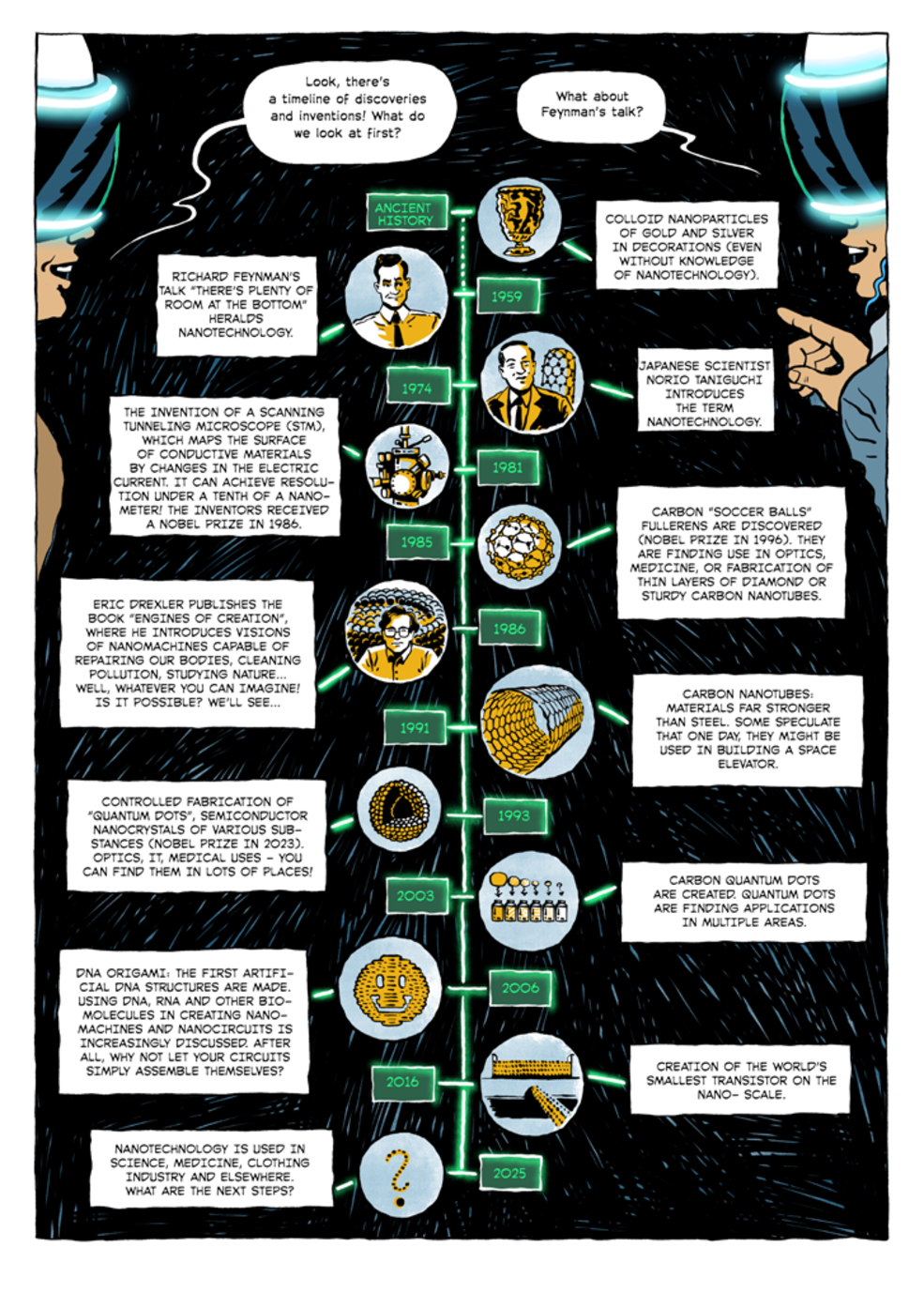
At the Institute of Physics of the Czech Academy of Sciences, we pondered how to communicate the nanoscale world to children and students. We naturally gravitated to the comic book: a story they can relate to, with high-schoolers as protagonists discovering how the nano-world works, what nanotechnology is and its history.
Another story character, the Nobel Prize-winning physicist Richard Feynman, whose “there is plenty of room in the bottom” speech ignited interest in the budding – not yet named – field of nanotechnology, acted as their guide. Thus, Secrets of The Nano-World was born.
Adding a worksheet for classroom use and creating several pages in a way that can be used as standalone infographics helped us create a toolkit of educational resources on nanotechnology.
The popularity of science comic books is on the rise
In some contexts, narratives and visuals can increase learning motivation, memory and understanding, and science communication and education professionals are increasingly interested in the potential of comic books. Nowadays, many excellent comic book resources are available in these fields.
To name just a few, there are wonderful science comics by neuroscientist and artist Matteo Farinella, “When The Earth…” trilogy of geophysical comic books, and countless graphic novel adaptations of events from science history, scientists’ lives and seminal works, including “Logicomix,” “Darwin: An Exceptional Voyage,” “Charles Darwin's On the Origin of Species,” the “It’s Her Story” series (such as the volume about Rosalind Franklin) and many more.
Not all have been necessarily created with the goal of educating in mind, but they are mostly doing a wonderful job.
Coupling comics and hands-on learning
In our case, we didn’t want to stop at just creating the comic book and worksheet. Early on, we decided to make all materials freely available under the CC-BY-SA license, so that they can be adapted, for example, translated or abbreviated for use in specific learning environments.
Finally, to couple it with hands-on learning, we developed an experimental setting, a glovebox containing LEGO bricks, enabling children to try out an exercise in the comic book, inspired by one of the “DIY Nano Book” activities using LEGO and kitchen mitts to illustrate in an analogy how the world on the nano-scale works.
The glovebox toured a couple of science fairs and local library workshops so far, eliciting much enthusiasm from children. After all, it’s one thing to merely read or hear about the “fat fingers, sticky fingers” problem of creating molecular machines; it’s another to try an analogical procedure in the macroscopic world with your own hands!
Our approach shows that not only do comics have a place in science communication and education, but when paired with other strategies, they can have a considerably greater impact. Despite its increasingly popular use, there is still much untapped potential of comics for science communicators and educators.
Questions yet to answer - hopefully soon!
The next step for us is to create another volume of the comic book, this time smoothly transitioning from the theme of nanotechnology, including topics such as DNA origami, to biophysics. A related worksheet is a must; in addition, we will run a workshop in our institute’s biophysics lab to enable interested students to gain hands-on experience on the discussed science and technology.
However, this is a single step by a single institution. How can we tap more of the science communication potential of comics, collaborate, and conduct more research on the effectiveness, benefits and potential pitfalls of using it in outreach and education? Hopefully, a new COST Action, ., may help bring together creators, researchers, communicators and educators across the world to explore these questions.
Julie Nekola Nováková
Institute of Physics, Czech Academy of Sciences